Guia de proporções faciais
Como ler terços faciais, espaçamento dos traços, referências da proporção áurea e distorção da câmera sem transformar uma razão em veredito.
Clara Bennett
Beauty-tech writer covering facial analysis, self-image, and practical AI tools.
Clara writes grounded explainers about facial analysis technology, digital self-image, and how people can use appearance tools without turning a score into a personal verdict.
Este guia explica proporções como referências para ler uma foto. Nenhuma razão isolada define beleza, saúde, identidade ou valor pessoal.
Proporções faciais são as relações visíveis entre testa, sobrancelhas, olhos, nariz, lábios, queixo, mandíbula e largura do rosto. Muitas pessoas pesquisam isso para entender por que uma foto parece equilibrada ou por que uma selfie distorce o rosto.
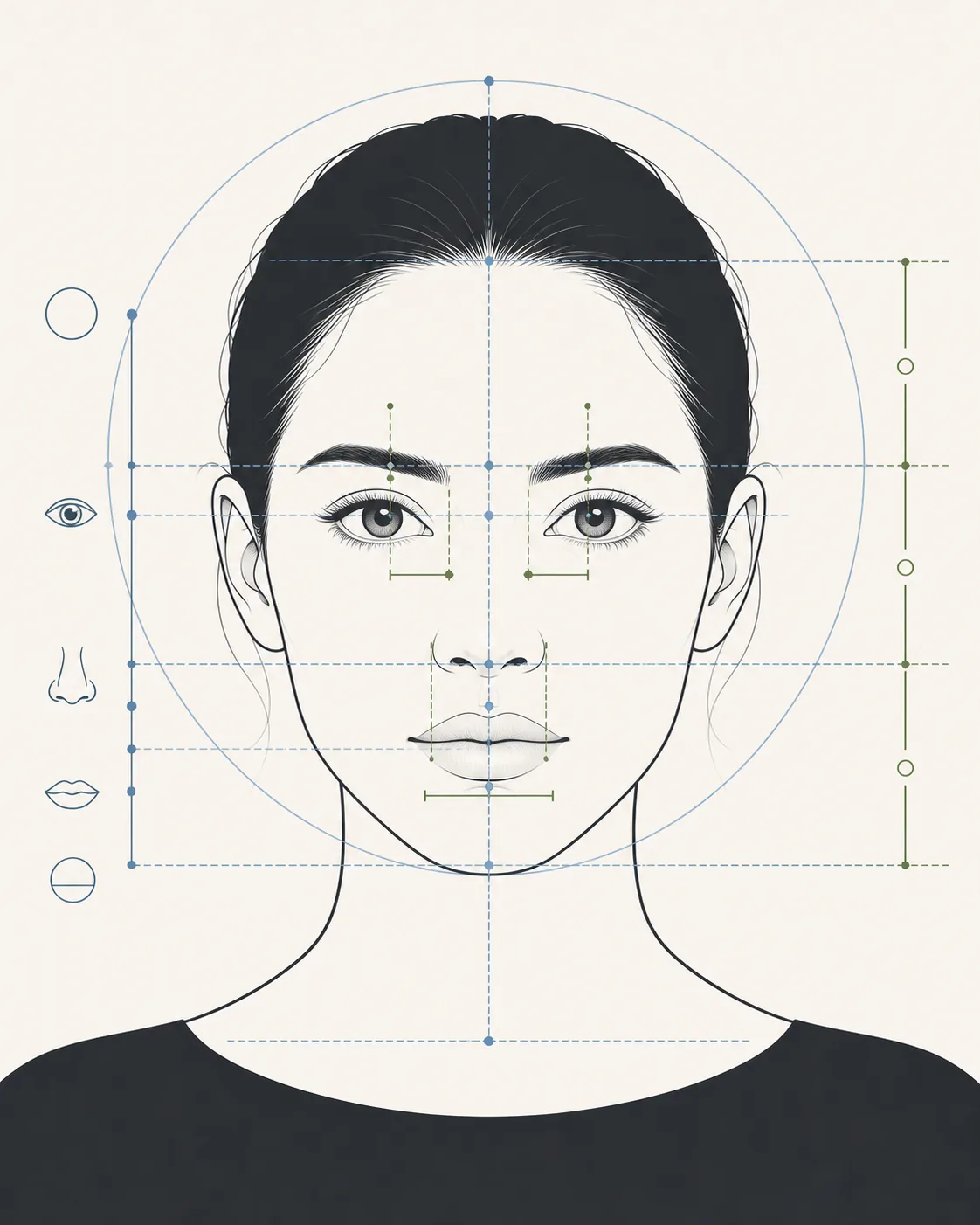
A resposta curta é que proporções são referências úteis, não leis fixas de beleza. Elas ajudam a descrever terços, espaçamento entre olhos e nariz, e o efeito da distância da câmera no nariz, no meio do rosto e na mandíbula.
Esta página conecta as calculadoras do site aos guias de simetria. Ela explica como ler terços, proporção áurea e simetria em conjunto, sem dar peso excessivo a um único número.
Research Context
Facial proportion research often treats ratios as one part of perception rather than a universal rule. One accessible example is the study on new golden ratios in facial attractiveness by Pallett, Link & Lee.
What facial proportions mean
Facial proportions are the distances and size relationships that make the face feel balanced or unbalanced in a photo. They include vertical divisions such as the upper, middle, and lower facial thirds, as well as horizontal spacing such as eye distance, nose width, mouth width, and jaw support. These relationships are easiest to read in a clear front-facing portrait.
A proportion is not the same as a score. A tool might say one third is longer than another or that a measurement is close to a reference ratio, but that does not mean the face is wrong. Human faces vary by age, ancestry, sex, expression, health history, lens distance, and natural individuality. Proportion analysis is most useful when it explains why a specific image reads the way it does.
Think of facial proportions as a map. A map can point out where the middle third is compressed by a close selfie, where the lower face looks stronger because the chin is closer to the camera, or where eye spacing looks wider because the head is slightly rotated. It is descriptive, not judgmental.
Vertical balance
Hairline-to-brow, brow-to-nose, and nose-to-chin relationships shape the overall rhythm.
Horizontal spacing
Eye distance, nose width, mouth width, and cheek width affect how centered the face reads.
Whole-face context
No single ratio works alone; proportions, symmetry, expression, and face shape interact.
Photo dependency
Lens distance, tilt, lighting, and expression can change how proportions appear.
How proportion analysis works
Most online proportion tools follow a simple pattern. They ask for visible landmarks, estimate distances between those landmarks, and compare the distances against reference relationships. A manual calculator may ask you to enter measurements. An AI-assisted tool may detect landmarks automatically, but it still depends on the clarity and fairness of the photo.
The best analysis explains the measurement boundaries. It should say whether it is reading facial thirds, golden-ratio style relationships, symmetry, feature spacing, or a combined score. If a tool does not explain its inputs, the result may still be interesting, but it is harder to trust or act on.
1. Start with a fair photo
Use a front-facing, eye-level image with even light and enough camera distance to avoid selfie distortion.
2. Locate landmarks
Identify reference points such as hairline, brow, base of nose, chin, eye corners, nose edges, mouth corners, and jaw outline.
3. Measure relationships
Compare vertical thirds, eye spacing, nose width, mouth width, face width, and lower-face support.
4. Check photo distortion
Look for head tilt, rotation, close lens effects, side lighting, and expression before interpreting the numbers.
5. Read multiple signals
Use the score as one clue and compare it with symmetry, harmony, and actual visual context.
Proportions vs symmetry
Facial proportions and facial symmetry answer different questions. Symmetry asks how evenly the left and right sides align around a center line. Proportions ask how the main features relate in size and spacing. A face can be symmetrical but still feel unusual if the camera compresses or expands one area. A face can be mildly asymmetrical but still read as proportionate and harmonious.
This is why the best internal-link role for this page is not to replace the homepage face symmetry test. It supports that tool. If a user sees a symmetry score and wonders whether thirds, golden ratio, or face shape explain the result, this guide gives the missing context.
For search intent, facial proportions is closer to an educational guide than a pure calculator query. Some readers want measurements, but many want a plain-language explanation of what proportions matter, why photos change them, and which online tool fits the question.
| Signal | What it helps explain | What to remember |
|---|---|---|
| Facial thirds | Vertical balance from hairline to brow, brow to nose, and nose to chin | Best read in a clear front-facing photo. |
| Eye spacing | How centered the eyes and upper face appear | Head rotation can change the apparent distance. |
| Nose width | Midface proportion and camera-distance effects | Wide-angle selfies can exaggerate the nose. |
| Mouth and chin | Lower-face balance and jaw support | Expression and angle can change the reading. |
| Overall harmony | How proportions, symmetry, and expression work together | A combined impression, not a single measurement. |
Key proportions to check
The most practical proportion checks are simple. Facial thirds help you read vertical balance. Eye spacing helps you read horizontal balance. Nose and mouth relationships help you understand the midface and lower face. Camera distance helps you avoid blaming your face for lens distortion.
None of these checks should be treated as a universal ideal. They are reference points that work best when compared across similar photos. If one image looks off, retake it with better distance and lighting before deciding that the measurement says something meaningful.
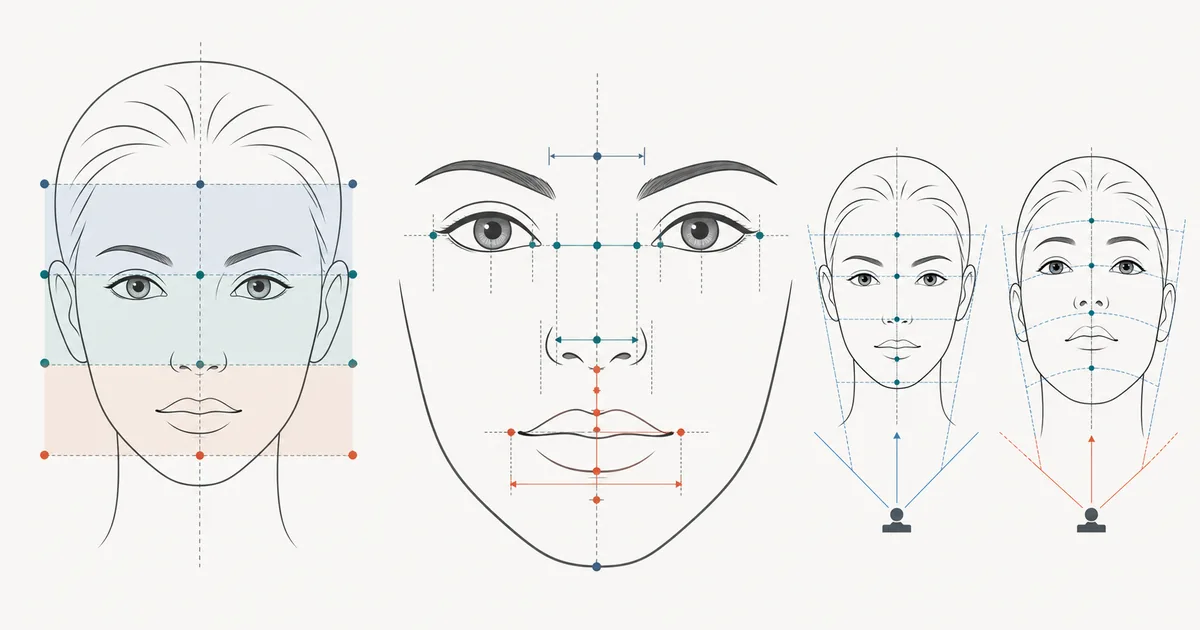
- Facial thirds: Compare hairline to brow, brow to base of nose, and base of nose to chin as a rough vertical guide.
- Eye spacing: The distance between the eyes affects the calm, centered feel of a front-facing photo.
- Nose width: Nose width is often compared with eye width, but close lenses can make it appear larger.
- Mouth width: Mouth width relative to pupils, nose, and jaw can influence lower-face balance.
- Chin and jaw support: The lower face can look stronger or softer depending on head angle and lens distance.
- Midface rhythm: Eye-to-nose and nose-to-mouth distances shape how long or compact the face reads.
How to test fairly
A fair check starts before the calculator. Use a neutral portrait, keep the camera near eye level, step back from the lens, and avoid a wide-angle selfie. If possible, use the rear camera or a portrait taken from a little distance. Keep the face relaxed and centered.
Then compare like with like. Do not compare a close selfie with a professional portrait or a smiling image with a neutral one. If a result changes dramatically, the photo is probably driving part of the difference. That is especially true for nose size, midface length, lower-face width, and facial thirds.
Fair Photo Checklist
- Use a front-facing portrait at eye level.
- Step back enough to reduce wide-angle distortion.
- Use soft front light and avoid strong side shadows.
- Keep expression relaxed and mouth position natural.
- Keep the full hairline-to-chin area visible when checking thirds.
- Avoid beauty filters, face reshaping, heavy smoothing, and extreme sharpening.
- Compare two or three similar photos before drawing a conclusion.
How to choose a tool
Choose the tool that matches your question. If you want to compare upper, middle, and lower face length, use a facial thirds test. If you want to explore selected ratio references, use a golden ratio calculator. If you want to see how left and right sides compare, use a face symmetry test. If you want a broader interpretation, use an AI face rating or facial harmony guide alongside the numbers.
A good tool should explain inputs, limits, privacy, and photo setup. A weak tool gives a harsh score without saying what was measured. Since face images are sensitive, privacy clarity is part of quality, not a side detail.
-
Clear measurement scope
The page should say whether it measures thirds, golden ratio references, symmetry, or a combined score. -
Useful interpretation
A result should explain what changed and what may be photo-related. -
Privacy transparency
Look for clear handling of uploaded images, deletion, training use, and third-party processing. -
Same-photo comparison
Prefer tools that let you compare consistent photos rather than treating one upload as final. -
Calm language
Avoid tools that shame users or claim one ratio proves beauty.
Proportion tests compared
The related tools on this site answer nearby but distinct intents. The facial thirds test is a calculator. The golden ratio face test is a reference-ratio calculator. The face symmetry test checks bilateral balance. The facial harmony guide explains the whole-face impression. This facial proportions guide connects those ideas in one educational page.
That separation avoids keyword cannibalization. A user searching facial proportions can learn which measurement to try next. A user searching golden ratio face test should land on the calculator. A user searching symmetrical face should use the homepage or the symmetry explainer.
| Tool | Best question | Use when | Limit |
|---|---|---|---|
| Facial proportions guide | How do the main face measurements relate? | Learning what to measure and how to interpret it | Educational, not a live measurement tool. |
| Facial thirds test | Are upper, middle, and lower thirds close? | Manual vertical proportion checks | Does not cover every feature relationship. |
| Golden ratio face test | Do selected measurements resemble ratio references? | Exploring 1.618-style comparisons | Ratios are references, not universal beauty laws. |
| Face symmetry test | How aligned are the left and right sides? | Bilateral balance checks | Symmetry is not the same as proportion. |
Privacy before uploading
Any face analysis tool should be treated as sensitive. A proportion check may feel casual, but a face photo can identify a person. Before uploading, read whether the service stores images, uses them to train models, sends them to third parties, or links them with an account.
If you only need manual proportion context, you can start with a calculator and avoid uploading a photo. If you do upload, use a tool that explains image handling clearly and do not upload someone else's face without appropriate permission.
Simple privacy rule
If a tool cannot explain what happens to your photo, choose a lower-risk option or use manual measurements instead.
Storage
Does the service delete the photo immediately, store it temporarily, or keep it long term?
Training use
Can your uploaded photo be reused to improve the AI model?
Third-party processing
Is the photo sent to another AI or cloud provider?
Account linkage
Are results tied to email, payment, profile, or IP data?
Deletion
Can you remove uploads or request deletion?
Consent
Do not upload another person or a minor without permission.
Research and limits
Research on facial attractiveness and facial perception does not support a single universal ratio. Studies discuss symmetry, averageness, sexual dimorphism, skin cues, familiarity, culture, and individual preference. Proportion can matter, but it is one signal among many.
AI tools add another layer. They can measure landmarks quickly, but a model learns from data and ratings that may be culturally narrow. A score can reflect photo conditions, dataset assumptions, or the tool's weighting choices as much as the face itself.
Use proportions as structured language. They can help you understand why a photo reads balanced, why a selfie feels distorted, and which tool to use next. They cannot measure personality, movement, expression in real life, or the way people respond to you as a whole person.
- New golden ratios in facial attractiveness: A study on vertical and horizontal distance relationships in facial perception. PubMed abstract.
- Facial attractiveness overview: A broad review covering symmetry, averageness, dimorphism, and other perception factors. NCBI/PMC review.
- Face AI and demographic differences: NIST reports on demographic performance differences in face recognition algorithms. NIST FRVT demographics.
- Biometric privacy warning: FTC guidance on privacy, security, bias, and misuse risks around biometric information. FTC biometric information warning.
Final thoughts
Facial proportions are useful when they help you name what you are seeing. They can explain thirds, spacing, lens distortion, and why one image feels different from another. They are less useful when they become a harsh rulebook.
The strongest approach is practical: take a fair photo, measure one thing at a time, compare related tools, and remember that proportions are only one layer of appearance. A face is not a spreadsheet, and a ratio is not a verdict.
If you want a next step, use the facial thirds test for vertical balance, the golden ratio face test for ratio references, and the face symmetry test for left-right balance. Read the results together instead of letting one score dominate the story.
Proportions are a map, not a verdict
The best reading combines measurements, photo setup, and the way features work together as a whole.
Try Facial Thirds Test