AI Face Rater Guide: How Face Rating AI Works and What Your Score Really Means
A practical, research-aware guide to AI face rater tools, facial attractiveness tests, score accuracy, photo conditions, and privacy before you upload a face photo.
Sarah Mitchell
Beauty-tech writer covering AI analysis tools, facial perception, privacy, and digital self-image.
Sarah writes practical explainers about beauty technology and consumer AI. Her work focuses on helping readers understand what automated tools can measure, where their limits begin, and how to use photo-based analysis without turning a score into a personal verdict.
This guide is written for people comparing AI face rater tools and trying to understand their scores. It explains common model behavior, photo-quality effects, privacy concerns, and published research without treating attractiveness as a fixed objective truth.
If you search for an AI face rater, you probably want one of two things: a quick score, or a better explanation of what that score is actually measuring. The first need is simple. You upload a photo, wait a few seconds, and get a face rating, attractiveness score, symmetry score, or feature breakdown. The second need is more important, because a number can feel strangely personal when it is attached to your face.
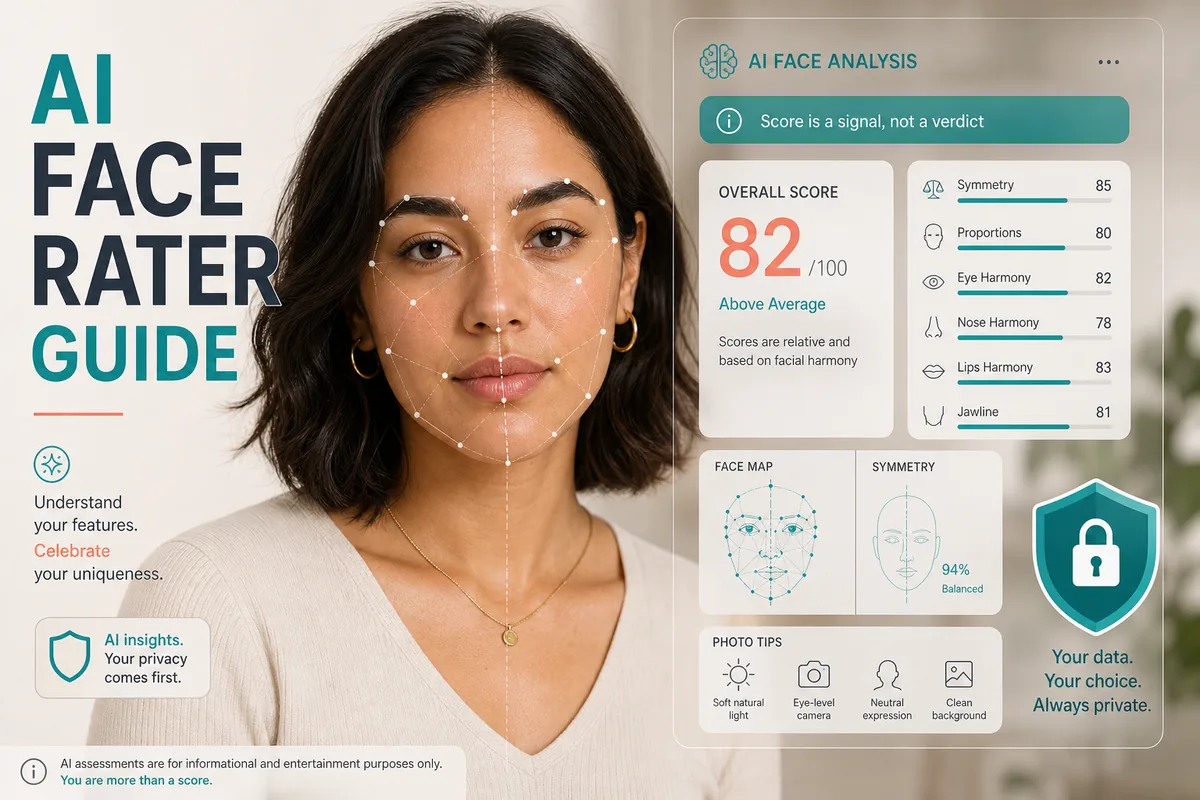
The short answer is this: face rater AI can be useful when it gives structured feedback about one photo, but it cannot measure your full attractiveness in real life. Most facial attractiveness test tools look at visible signals such as landmark positions, symmetry, facial proportions, photo clarity, skin cues, expression, and model-learned patterns from rated images. Those signals can be consistent, but they are still limited by the photo, the training data, and the assumptions built into the tool.
This guide explains how AI face rating usually works, how accurate these tools are, why the same person can get different scores in different images, and what to check before uploading a face photo. The goal is not to talk you out of using an AI face rater. It is to help you use one with better expectations and less overthinking.
Quick Background
Research on facial attractiveness usually treats beauty perception as multi-factorial, involving symmetry, averageness, dimorphism, skin cues, familiarity, culture, and individual experience. A useful broad review is available from NCBI/PMC.
What Is an AI Face Rater?
An AI face rater is a software tool that analyzes a face photo and returns a score, category, or written feedback about visible facial features. Some tools call this an AI attractiveness test, face attractiveness analyzer, beauty score, face rating app, or rate my face AI tool. The labels differ, but the basic job is similar: convert one image into structured observations.
A careful AI face rater should not claim to know whether someone is attractive as a person. Real-world attraction includes movement, voice, warmth, style, confidence, context, and personal preference. A static image only captures a slice of that. What AI can do more reliably is inspect the photo in a consistent way: where facial landmarks appear, how balanced the face looks, how clear the image is, and how closely visible patterns match examples the model has learned from.
This is why the healthiest way to read a face rating score is as camera-readiness feedback. It can tell you whether a specific photo appears balanced, clear, and model-friendly. It should not tell you what you are worth.
It rates an image
The score comes from one uploaded photo, not from seeing your face in motion or in everyday social context.
It follows a model
Different face rater AI tools can use different training data, feature weights, and scoring scales.
It can be useful
A good tool can highlight symmetry, proportions, lighting, expression, and photo setup issues.
It has limits
Subjective attractiveness, cultural preference, personality, and presence cannot be reduced to one number.
How AI Face Rating Usually Works
Most AI face rating tools hide the technical details behind a simple upload button, but the workflow is usually easier to understand than the marketing suggests. The system has to find the face, map important points, measure relationships between those points, check image quality, and then translate those signals into a score or explanation.
The exact model varies by platform. Some tools emphasize geometric measurements such as facial symmetry and golden ratio style proportions. Others use deep learning models that have been trained to predict how groups of people rated similar images. Many modern tools combine both approaches.
1. Face detection
The tool first locates the face in the image and separates it from the background. If the face is turned, cropped, heavily shadowed, or partly covered, this step can already become less reliable.
2. Landmark mapping
The model estimates points around the eyes, brows, nose, mouth, jawline, chin, and face outline. These landmarks become the measurement grid for later analysis.
3. Symmetry and proportion checks
The tool compares left-right balance, feature spacing, facial thirds, eye distance, nose-to-mouth relationships, jawline position, and overall facial harmony.
4. Photo-quality signals
Lighting, blur, resolution, camera angle, expression, skin texture, contrast, and filters can affect what the model sees before it ever evaluates facial structure.
5. Score generation
Finally, the system combines geometric measurements and model-learned patterns into a 1-10 score, 0-100 score, percentile, category, or written feedback.
How Accurate Are AI Face Raters?
The honest answer is that AI face rater accuracy depends on what you mean by accurate. If the question is whether a tool can consistently locate eyes, nose, lips, and jawline in a clear front-facing portrait, many systems can do that reasonably well. If the question is whether AI can give a universal beauty score that everyone would agree with, the answer is no.
Face rating AI is strongest when it measures visible structure and applies the same scoring logic repeatedly. It is weaker when it tries to convert human attraction into a single number. Even research models that predict attractiveness are usually predicting average ratings from a particular dataset, not discovering an absolute standard.
A practical rule is to compare results within the same tool and under similar photo conditions. A score changing from 72 to 78 in the same tool may tell you something about lighting, angle, or expression. A 7.8 from one app and an 84 from another app are not automatically comparable, because the scales and models may be different.
| What the tool measures | How reliable it can be | What to remember |
|---|---|---|
| Face detection | Usually strong in clear, front-facing photos | Reliability drops with heavy shadows, side angles, occlusion, or low resolution. |
| Landmark placement | Moderate to strong when the image is clean | Hair, glasses, facial hair, makeup, and expression can shift detected points. |
| Symmetry score | Useful as a same-tool comparison | It reflects one photo and does not equal total attractiveness. |
| Facial harmony | Helpful but model-dependent | Different tools may weight eyes, nose, jaw, lips, and proportions differently. |
| Overall attractiveness score | Most subjective | It predicts a model's learned scoring pattern, not a universal truth. |
Why Your Face Rating Score Can Change Between Photos
Many people assume a changing score means the AI face rater is broken. Sometimes it is simply reacting to different input. A close selfie is not the same visual object as a portrait taken at eye level from farther away. A soft smile is not the same as a neutral expression. A front-lit photo is not the same as one with a lamp on only one side of the face.
This matters because a facial attractiveness test evaluates pixels before it evaluates a person. If the pixels exaggerate the nose, hide one cheek in shadow, blur the jawline, or lift one eyebrow mid-expression, the model may read those visual changes as structural differences.
- Camera distance: Close selfies can exaggerate central features and alter facial proportions compared with a standard portrait.
- Lens distortion: Wide-angle phone lenses can stretch depth and make features near the camera appear larger.
- Head angle: A small tilt or turn can make one eye, cheek, or jawline look higher or stronger.
- Lighting: Side lighting creates shadows that may look like asymmetry, texture, or feature imbalance.
- Expression: Smiles, tension, raised brows, and squinting can move landmarks in ways the model measures.
- Filters and editing: Beauty filters, sharpening, skin smoothing, and face reshaping can confuse the meaning of the result.
How to Use an AI Face Rater Without Overthinking the Score
The best way to use a rate my face AI tool is to control the photo conditions and treat the result as feedback about that setup. You are not trying to find a permanent number. You are trying to understand how lighting, angle, expression, and feature balance affect one image.
For a fair test, take a front-facing photo at eye level, use even light, keep your expression relaxed, remove heavy obstructions, and avoid beauty filters. Then repeat the same setup two or three times. If the feedback is consistent across similar images, it is more meaningful than one surprising score from one dramatic selfie.
Photo Checklist for a More Stable Result
- Use a clear, front-facing portrait with the camera at eye level.
- Stand a little farther back instead of using an ultra-close selfie.
- Use soft, even light from the front rather than harsh side light.
- Keep your face relaxed and avoid exaggerated expressions.
- Remove sunglasses, masks, heavy shadows, and hair covering key landmarks.
- Avoid filters, face reshaping, skin smoothing, or extreme sharpening.
- Compare similar photos within the same tool instead of comparing random scores across different apps.
How to Choose the Best AI Face Rater
The best AI face rating tool is not necessarily the one that gives the highest score or the most dramatic report. A stronger tool is transparent about what it analyzes, careful about privacy, and constructive in how it explains results. It should help you understand a photo without making you feel reduced to a number.
When comparing face rating apps, look for signs that the product understands both the technical and human sides of the task. A tool that explains photo conditions, provides feature-level context, and avoids harsh language is usually more useful than one that only gives a big score.
-
Clear scoring explanation
The page should explain whether the score reflects symmetry, harmony, proportions, skin cues, image quality, model prediction, or a mix of factors. -
Feature breakdown
A useful face attractiveness analyzer should provide context beyond one number, such as symmetry, lighting, expression, or facial harmony notes. -
Privacy clarity
The service should state whether photos are stored, deleted, used for training, shared with third parties, or linked to an account. -
Constructive tone
Avoid tools that use insulting, ranking-heavy, or shame-based language. Feedback should be practical and respectful. -
Photo guidance
Good tools tell users how to take a better test photo, because poor input can produce unstable output. -
Reasonable claims
Be cautious with pages that promise perfect accuracy, universal objectivity, or completely bias-free scoring without explaining evidence.
AI Face Rater vs Face Symmetry Test vs Facial Harmony Test
AI face rater is a broad phrase. It often overlaps with facial symmetry tests, facial harmony tests, golden ratio calculators, and facial attractiveness tests. The difference is the question each tool is trying to answer.
Knowing the difference helps you choose the right page and avoid reading too much into one score. A symmetry test is about left-right balance. A harmony test is about how features work together. A face rating tool usually combines several signals into one overall score.
| Tool Type | Main question | Best for | Limit |
|---|---|---|---|
| AI face rater | How does this photo score overall according to the model? | Fast, combined feedback on one image | Most subjective because it blends many signals into one number |
| Face symmetry test | How balanced are the left and right sides of the face? | Understanding left-right alignment and photo angle effects | Symmetry is only one part of appearance |
| Facial harmony test | How well do facial features work together proportionally? | Reading structure, spacing, and overall balance | Harmony standards vary by model and context |
| Golden ratio calculator | Do facial proportions resemble selected mathematical ratios? | People curious about proportion measurements | Mathematical ratios are not universal beauty rules |
Privacy Checklist Before Uploading Your Face
A face photo is sensitive data. Even when a tool feels casual or entertaining, you are still uploading an image that may identify you. That does not mean every AI face rater is unsafe, but it does mean the privacy policy matters.
Before using any facial attractiveness test, check how the platform handles your photo. The most important details are storage, deletion, model training, third-party processing, account linkage, and whether the service makes special rules for minors or photos of other people.
Privacy rule of thumb
If a tool does not clearly explain what happens to your photo, do not upload an image you would not want stored, reused, or connected to you.
Storage time
Does the service delete photos immediately, keep them temporarily, or store them indefinitely?
Training use
Does the tool use uploaded photos to train or improve AI models?
Third-party services
Does the app process your photo on its own servers or send it to another AI provider?
Deletion control
Can you request deletion or remove your uploads from an account?
Account linkage
Does the upload connect to your email, payment account, IP address, or profile?
Consent
Do not upload someone else's face, especially a minor's face, without appropriate permission.
Research, Bias, and Real Limits
The research background for AI face rating is more complicated than most tool pages suggest. Studies have examined facial symmetry, averageness, sexual dimorphism, skin cues, and cross-cultural patterns, but none of that turns attractiveness into a single universal formula. Human judgment is influenced by biology, culture, familiarity, emotion, and individual preference.
Machine learning adds another layer. A model can learn from large sets of labeled images, but those labels come from people, and those people bring their own preferences and social context. If the training data is narrow, the output may reflect that narrowness. If the photo conditions differ from the training examples, the score may become less stable.
The safest wording is this: an AI face rater can consistently apply its own learned scoring pattern to one image. That is useful, but it is not the same as unbiased truth.
- Facial attractiveness overview: A broad review covers symmetry, averageness, dimorphism, skin cues, familiarity, and individual variation in attractiveness judgments. NCBI/PMC review.
- Symmetry is not the whole story: Recent research discusses why averageness and femininity may predict ratings more consistently than symmetry alone in natural faces. Scientific Reports.
- Cross-cultural perception: Research on different viewer groups highlights how exposure and cultural context can shape facial attractiveness judgments. Scientific Reports.
- Face AI and demographic differences: NIST reports on face recognition show that facial AI systems can display demographic performance differences, which is relevant background when discussing model bias. NIST FRVT demographics.
- Biometric privacy: The FTC warns that misuse of biometric information can create privacy, security, bias, and discrimination risks. FTC biometric information warning.
Final Thoughts
An AI face rater can be interesting, useful, and even practical when you understand what it is doing. It can point out that one photo has uneven light, that a close selfie distorted your proportions, that your symmetry score changes with head angle, or that a more neutral portrait gives a steadier result. Those are helpful observations.
The trouble starts when a score becomes a verdict. A facial attractiveness test cannot see your presence, humor, movement, style, relationships, or the way people actually respond to you in real life. It can only evaluate the image and the model's learned pattern. Use it for feedback. Do not hand it the authority to define you.
If you do test, use a clear photo, read the feature notes, compare similar images, and choose tools that explain their method and respect your privacy. That is the difference between using face rating AI as a mirror with context and letting it become a number without meaning.
Use the score as a signal, not a verdict
The most useful approach is to compare similar photos, look at the pattern, and treat the feedback as one structured lens on a single image.
Try AI Face Rating