Facial Harmony: Meaning, Test, and Proportions
A practical guide to facial harmony, face harmony, facial harmony tests and scores, proportions, symmetry, photo conditions, and realistic interpretation.
Clara Bennett
Beauty-tech writer covering face analysis, self-image, and practical AI tools.
Clara writes grounded explainers about facial analysis technology, digital self-image, and how people can use appearance tools without turning a score into a personal verdict.
This guide explains facial harmony as a visual and proportion-based concept. It does not claim that one ratio, score, or AI model can define beauty or personal value.
Facial harmony describes how features work together as a whole. It is not perfect symmetry or one fixed formula: eyes, brows, nose, lips, jaw, forehead, midface, and expression all contribute to the impression.
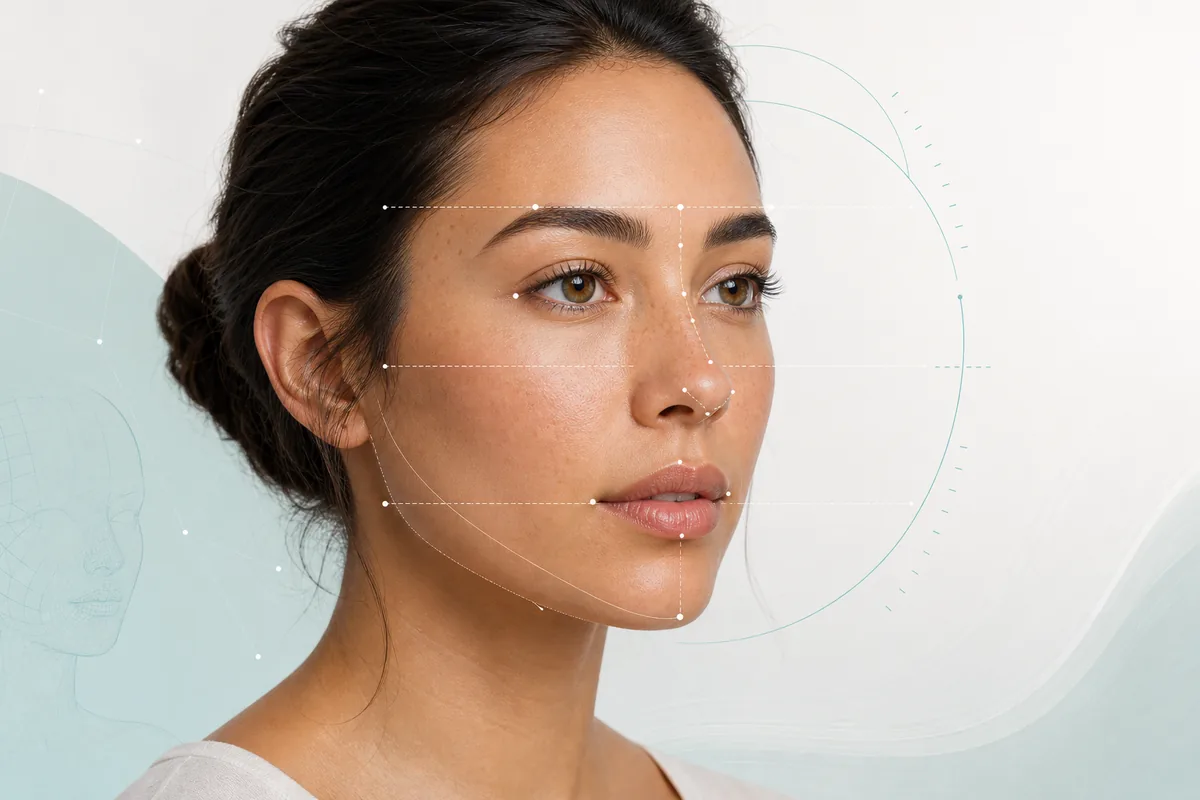
Face harmony can still look balanced when some features are not conventionally ideal. Symmetry helps, but proportion, spacing, expression, and photo conditions also shape the result.
This guide explains facial harmony, facial harmony tests, facial harmony scores, facial proportions, facial harmony vs symmetry, and how to read an online result without treating it as a verdict.
Quick Background
Research on facial attractiveness treats perception as multi-factorial. A broad review covering symmetry, averageness, dimorphism, skin cues, and individual variation is available from NCBI/PMC.
What Facial Harmony Means
Facial harmony is the overall sense that facial features fit together. It is not a single measurement. It is a combined impression created by proportion, spacing, symmetry, facial thirds, expression, and how clearly the image presents the face. In everyday language, a harmonious face feels visually coherent: no single feature overwhelms the rest, and the eyes, nose, lips, cheeks, jaw, and forehead read as part of the same structure.
That does not mean every feature must match a textbook ideal. Many memorable faces have distinctive noses, uneven brows, strong jaws, soft cheeks, or asymmetrical smiles. Those traits can still feel harmonious when they work with the rest of the face. Harmony is closer to composition than perfection.
This is why facial harmony is a better concept than a harsh beauty score for many users. It gives you a way to talk about balance and proportion without pretending that a face is either correct or incorrect. A facial harmony test can help you notice patterns, but it should not be treated as the final word on attractiveness.
Whole-face balance
Harmony looks at the relationship between features, not one isolated feature.
Proportion and spacing
Facial thirds, eye spacing, nose-to-lip distance, and jaw balance can all affect the result.
Symmetry as one signal
Left-right balance helps, but perfect symmetry is neither common nor required.
Photo context
Angle, lens distance, lighting, and expression can make harmony look stronger or weaker.
How a Facial Harmony Test Reads a Face
A facial harmony test usually detects landmarks, compares distances, and summarizes relationships among facial regions. Some tools turn those signals into a facial harmony score, but the number is only a model output.
To understand how to score facial harmony responsibly, compare the same signals across similar photos: facial thirds, spacing, visible symmetry, expression, lighting, and lens distance.
1. Face detection
The tool finds the face and checks whether key areas such as eyes, nose, mouth, brows, and jawline are visible.
2. Landmark mapping
It estimates points around the features and face outline so distances and angles can be compared.
3. Proportion checks
It looks at facial thirds, eye spacing, midface balance, nose-to-mouth distance, lip position, and jaw support.
4. Symmetry context
It compares left-right balance, but reads it as one part of the whole rather than the only factor.
5. Score and explanation
It converts those observations into a harmony label, score, or practical summary that should be read with photo quality in mind.
Facial Harmony vs Facial Symmetry
Facial harmony and facial symmetry are related but not identical. Symmetry compares left and right; harmony asks whether the features work together as a whole.
A face can have good facial harmony with mild asymmetry or features that do not fit a single beauty formula. Context, proportion, expression, and the photo itself all matter.
| Signal | What it can tell you | What to remember |
|---|---|---|
| Facial thirds | Whether upper, middle, and lower face areas appear proportionate | Natural variation is normal; thirds are guides, not laws. |
| Feature spacing | How eyes, nose, lips, and jaw relate visually | Lens distance and angle can change spacing in a photo. |
| Symmetry | How evenly left and right sides align | Symmetry supports harmony but does not define it. |
| Expression | Whether tension or movement affects the result | A relaxed face usually gives cleaner feedback. |
| Overall score | A model-based summary of one image | Useful as context, not as universal truth. |
Facial Proportions That Affect Harmony
Facial proportions are useful reference points, not a universal beauty recipe. Facial thirds, eye spacing, nose position, lip-to-chin balance, and jaw support can all influence how a face reads.
Some people also ask whether the E-line determines facial harmony. It can help describe lip-to-profile relationships, but one profile reference cannot measure the harmony of the whole face.
- Facial thirds: Balanced upper, middle, and lower thirds often make the face feel proportionate, though natural variation is normal.
- Eye spacing: The distance between the eyes affects how centered and calm the face reads in a front-facing photo.
- Midface balance: Nose length, cheek volume, and the distance from eyes to mouth shape the overall rhythm of the face.
- Lip and chin relationship: The lower face can feel more or less balanced depending on lip position, chin shape, and jaw support.
- Jaw and face shape: A jawline does not need to be sharp to be harmonious, but it should visually support the rest of the face.
- Expression: Relaxed eyes and a natural mouth can make the same proportions read more harmonious than a tense expression.
- E-line as one profile reference: The E-line can help discuss lip-to-profile relationships, but it does not determine facial harmony by itself or replace a full-face view.
How to Use a Facial Harmony Test Fairly
For a fair facial harmony test, use a front-facing photo with soft light, the camera near eye level, and a relaxed expression. Avoid heavy filters and very close selfies.
Compare two or three images made under similar conditions. A repeated pattern is more useful than a single facial harmony score viewed in isolation.
Photo Checklist for Better Harmony Feedback
- Use a clear front-facing portrait at eye level.
- Keep your face relaxed and avoid exaggerated smiles or tension.
- Use soft, even front light rather than strong side shadows.
- Step back from the lens to reduce distortion in the nose and midface.
- Keep brows, eyes, nose, lips, cheeks, jawline, and chin visible.
- Avoid face reshaping, beauty filters, heavy smoothing, and extreme sharpening.
- Compare similar photos within the same tool instead of mixing unrelated scores.
How to Choose a Facial Harmony Test
A good facial harmony tool should explain what it analyzes. If a page only gives a score and uses harsh language, it is less useful than a tool that separates symmetry, proportions, photo quality, and overall harmony. The point is not to flatter the user. The point is to make the result understandable.
Privacy also matters. Facial photos are sensitive, even when the tool is used for curiosity. Before uploading, check whether the service stores images, uses them for training, connects results to an account, or explains deletion. A responsible tool should be clear about those tradeoffs.
-
Clear measurement boundaries
The tool should say whether it evaluates symmetry, facial thirds, proportions, photo quality, or a combined score. -
Feature-level context
A useful report explains which relationships influence the result instead of showing only one number. -
Photo guidance
The page should teach users how to take a fair photo before interpreting the score. -
Privacy transparency
Look for clear statements about storage, deletion, model training, third-party processing, and account linkage. -
Constructive tone
Avoid tools that shame users, exaggerate objectivity, or imply a score defines personal value. -
Related explanations
Strong tools link to supporting guidance on face symmetry, AI face rating, photo distortion, and score interpretation.
Facial Harmony Test vs Symmetry Test
People often use these terms interchangeably, but they answer different questions. A facial harmony test asks how the parts of the face relate to one another. A face symmetry test asks how evenly the left and right sides align. A golden ratio calculator asks whether selected measurements resemble a mathematical proportion. An AI face rater usually blends several signals into one broader score.
For this site, the new facial harmony guide does not replace the homepage face symmetry test or the AI face rating page. It supports them by explaining a distinct concept: why whole-face balance can matter even when symmetry is only moderate, and why one mathematical ratio should not be treated as a universal rule.
| Tool Type | Main question | Best for | Limit |
|---|---|---|---|
| Facial harmony test | Do the facial features work together proportionally? | Understanding whole-face balance | Depends on model weights and photo quality |
| Face symmetry test | How balanced are the left and right sides? | Checking bilateral alignment | Symmetry is only one part of harmony |
| Golden ratio calculator | Do selected measurements match chosen ratios? | Exploring proportion references | Ratios are not universal beauty rules |
| AI face rater | How does the model score the photo overall? | Quick combined feedback | Most subjective because it blends many signals |
Privacy Before Uploading a Face Photo
Any tool that analyzes a face photo should be treated with care. A facial harmony test may feel casual, but the image can still identify you. That does not mean you should never use one. It means you should understand where the photo goes and what the service does with it.
Before uploading, read the privacy policy and look for concrete answers. Does the tool delete images after processing? Are uploads used for model training? Is the analysis handled by another provider? Can you request deletion? Are results linked to an account or email?
Simple privacy rule
If the tool does not clearly explain photo handling, use a lower-risk image or choose a service with more transparent policies.
Storage
Check whether photos are deleted immediately, retained temporarily, or stored long term.
Training use
Confirm whether uploads can be reused to train or improve AI models.
Third-party processing
Find out whether the app sends images to another AI or cloud provider.
Account linkage
Understand whether your photo is tied to an email, profile, payment account, or IP address.
Deletion
Look for an option to delete uploads or request removal.
Consent
Do not upload someone else's face, especially a minor's face, without appropriate permission.
Research, Bias, and Real Limits
Research on facial perception does not reduce attractiveness to one ratio. Studies often discuss symmetry, averageness, sexual dimorphism, skin cues, familiarity, cultural context, and individual preference. That is why a responsible facial harmony guide should avoid claiming that one measurement can define a face.
AI adds another limitation. A model can learn patterns from rated faces, but those ratings come from people and datasets with their own biases. If the training set is narrow or the photo conditions are unusual, a score may reflect the model's assumptions as much as the user's face. This is especially important for appearance-sensitive tools, where a number can feel personal.
Use facial harmony analysis as structured feedback on one image. It can help explain proportions, photo setup, and overall balance. It cannot measure personality, presence, confidence, movement, or how people respond to you in real life.
- Facial attractiveness overview: A broad review discusses symmetry, averageness, dimorphism, skin cues, and variation in attractiveness judgments. NCBI/PMC review.
- Symmetry is not the whole story: Recent research discusses why averageness and femininity may predict ratings more consistently than symmetry alone in natural faces. Scientific Reports.
- Cross-cultural perception: Research on different viewer groups shows how exposure and cultural context can affect facial judgments. Scientific Reports.
- Face AI and demographic differences: NIST reports on face recognition show demographic performance differences, relevant context for facial AI bias. NIST FRVT demographics.
- Biometric privacy: The FTC warns that misuse of biometric information can create privacy, security, bias, and discrimination risks. FTC biometric information warning.
Final Thoughts
Facial harmony is useful because it gives language to something people notice intuitively: whether a face feels balanced as a whole. It includes symmetry, but it is wider than symmetry. It includes proportions, but it is softer than a calculator. It includes photo conditions, because the camera can make real features look more or less coherent than they do in person.
The best way to use this concept is calmly. If you run a facial harmony test, use a fair photo, read the explanation, and compare similar images. Do not treat one score as a life sentence or one ratio as a beauty law. A face is not a spreadsheet.
If you want a practical next step, try the AI face rating page with a clear portrait, then compare the harmony notes with the symmetry score. The difference between those two signals is often where the most useful insight appears.
A balanced face is not a mathematical checklist
The most useful reading combines proportion, expression, symmetry, and photo setup. Treat the score as context, not as a final judgment.
Try AI Face Rating