Asymmetrical Face: Causes, What Is Normal, and When to Worry
A practical, calm guide to facial asymmetry, selfie distortion, normal left-right differences, and the warning signs that should not be treated as a beauty issue.
Clara Bennett
Beauty-tech writer covering face analysis, self-image, and practical AI tools.
Clara writes grounded explainers about facial analysis technology, digital self-image, and how people can use appearance tools without turning a score into a personal verdict.
This guide explains appearance-related asymmetry and safety signals. It is informational, not medical advice, and it does not diagnose facial weakness or any health condition.
An asymmetrical face means the two sides of the face do not match perfectly. That sounds dramatic, but it is ordinary. Eyebrows rarely sit at identical heights, one smile corner may move farther, one cheek may look fuller, and a close selfie can make all of those small differences feel larger than they are.
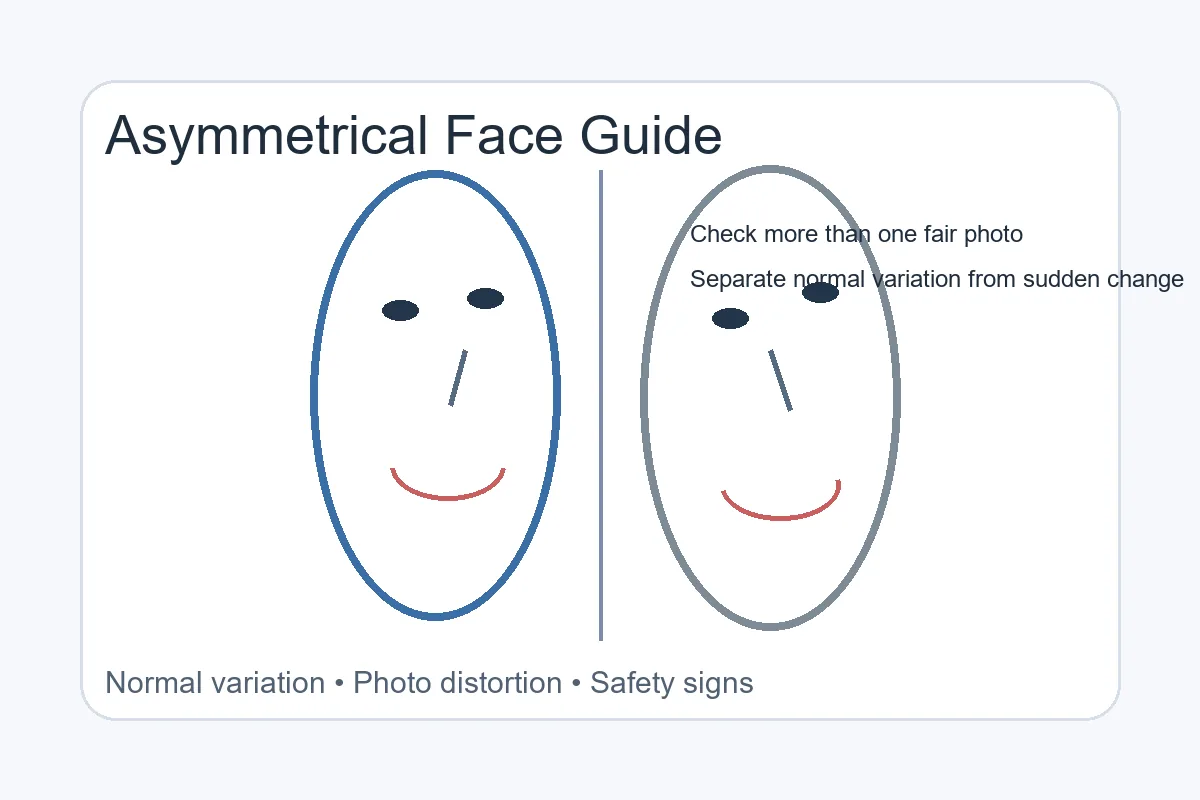
The practical question is not whether your face is perfectly even. It is whether the difference is long-standing and normal, created by the photo, or new enough to deserve medical attention. A beauty tool can help you compare images, but it cannot diagnose weakness, nerve problems, dental issues, or injury.
This guide is for people searching asymmetrical face, why is my face asymmetrical, uneven smile, facial asymmetry check, or how to fix an asymmetrical face in photos. It separates normal variation from photo artifacts and gives a clear safety line for sudden changes.
Source Note
Medical and university sources consistently note that mild asymmetry is common, while sudden one-sided facial weakness should be evaluated promptly. A plain overview is available from Penn Medicine.
What Does an Asymmetrical Face Mean?
Facial asymmetry is the visible difference between the left and right sides of the face. It can involve brow height, eye shape, cheek volume, nose position, smile movement, jawline, chin position, or the way soft tissue sits over the bone. In most people, these differences are subtle and stable.
A stable asymmetrical face is usually not a problem by itself. Human faces grow through genetics, chewing habits, sleeping positions, dental development, expression patterns, aging, and ordinary soft-tissue changes. The result is a face that is balanced enough to read naturally, even if it is not mirror-perfect.
The important distinction is timing. A difference you have always noticed in photos is very different from sudden drooping, weakness, numbness, pain, or trouble speaking. Search pages often mix cosmetic and medical meanings together; a helpful guide should keep them separate.
Stable asymmetry
A small difference that has been present for years is often ordinary facial variation.
Expression asymmetry
Smiles, speech, raised brows, and jaw tension can move one side more than the other.
Structural asymmetry
Jaw, bite, nose, or cheek differences can shape how the face reads at rest.
Sudden weakness
New drooping or loss of movement is not a photo-quality issue and should be checked.
Common Causes of Facial Asymmetry
There is no single cause of an asymmetrical face. Some differences come from bone and dental structure, some from soft tissue, and some from how the photo was taken. For searchers, the most useful explanation is a practical map: what is likely normal, what can be improved in photos, and what belongs with a clinician.
Cosmetic advice online often jumps directly to exercises, fillers, or surgery. A calmer approach starts by identifying the type of asymmetry. Is it only visible in selfies? Does it change with expression? Is it related to jaw pain or bite changes? Did it appear suddenly? The answer changes what the next step should be.
1. Normal development
Genetics, growth, chewing preference, and natural muscle use can create small long-term differences.
2. Camera and lighting
Close lenses, side shadows, and head rotation can make one side look wider, lower, or more dominant.
3. Dental or jaw factors
Bite changes, TMJ problems, missing teeth, or jaw growth patterns can affect the lower face.
4. Aging and soft tissue
Skin elasticity, volume loss, and habitual expressions may make asymmetry more visible over time.
5. Medical causes
Bell's palsy, stroke, injury, tumors, infections, or nerve problems can cause new or stronger asymmetry and need professional evaluation.
Why Selfies Make Asymmetry Look Worse
Many people first worry about facial asymmetry after seeing a flipped selfie. The front camera is often close to the face, slightly above or below eye level, and using a wide lens. That geometry can enlarge the nose, shift the midface, and make one side appear stronger when the head is not perfectly centered.
Mirrors add another layer. You are used to the mirrored version of your face, so an unflipped photo can look unfamiliar even when nothing is wrong. The unfamiliarity can feel like asymmetry because your brain is comparing two versions of the same face.
Before deciding your face is uneven, take a neutral photo from farther away, at eye level, with even light. If the difference becomes smaller, the problem was mostly camera setup, not facial structure.
| Photo or cause | Likely effect | Better next step |
|---|---|---|
| Close selfie | Makes the nose and midface look larger and can shift balance | Step back and crop later |
| Side lighting | Creates shadows that look like uneven cheeks or eyes | Use soft front light |
| Head tilt | Raises one eye or jawline visually | Level the camera and face |
| Mirrored preview | Makes the normal photo look unfamiliar | Compare several neutral photos |
| Big smile | Moves one side more than the other | Retest with a relaxed expression |
How to Check Facial Asymmetry Fairly
A fair facial asymmetry check should be boring. Use a front-facing portrait, not a dramatic selfie. Keep the camera at eye level, step back enough to reduce lens distortion, relax your mouth, and use soft front light. The goal is not to create the most flattering image; it is to create a repeatable image.
Then compare two or three photos taken under the same conditions. If one image looks very uneven and the others look normal, treat the first image as a setup problem. If the same pattern appears every time, it may simply be your stable facial structure, or it may be worth discussing with a dentist, orthodontist, dermatologist, or physician depending on the concern.
- Camera distance: Step back and crop later instead of holding the phone close to your face.
- Head position: Keep ears, eyes, and shoulders level so the midline is not tilted.
- Lighting: Use even front light; side light can carve shadows that mimic imbalance.
- Expression: A neutral mouth and relaxed brows reduce temporary movement asymmetry.
- Repeatability: Compare similar photos rather than one mirror shot and one close selfie.
- Context: Look at function, comfort, and timing, not appearance alone.
When an Asymmetrical Face Needs Medical Attention
Most facial asymmetry is not urgent. But sudden facial changes are different. If one side of the face droops, feels weak or numb, cannot smile normally, or appears with slurred speech, arm weakness, confusion, severe headache, eye closing trouble, or new pain, do not use an online symmetry test as the next step. Seek urgent medical help.
Stroke resources use FAST because facial drooping can be one warning sign. Bell's palsy can also cause sudden one-sided weakness and needs medical evaluation to confirm the cause and protect the eye if closing becomes difficult. The safest rule is simple: new loss of movement or sensation deserves real care, not a beauty explanation.
Fast safety checklist
- Sudden drooping on one side of the face
- New trouble smiling, blinking, speaking, or keeping saliva in the mouth
- Face change with arm weakness, confusion, dizziness, or speech trouble
- New facial numbness, severe pain, injury, or rapidly worsening swelling
- Eye dryness or inability to close one eye after new weakness
What Can Improve an Asymmetrical Face in Photos?
If the asymmetry is mainly photographic, the fixes are practical: use a longer camera distance, center the face, avoid strong side light, keep the chin level, and choose a relaxed expression. These changes do not alter your face; they reduce visual noise so the image is fairer.
If the concern is structural or functional, online tips should be treated carefully. Facial exercises may help expression awareness for some people, but they are not a universal fix. Dental bite issues, jaw pain, injury, facial paralysis, or sudden weakness belong with qualified professionals. Cosmetic options such as fillers, orthodontics, surgery, or skin treatments require individual assessment and should not be chosen from a score alone.
-
Photo setup first
Improve the test conditions before interpreting the result. -
Function matters
Pain, bite changes, eye closure, or weakness are more important than a beauty score. -
Avoid harsh comparisons
Perfectly mirrored faces can look unnatural; mild asymmetry is normal. -
Ask the right professional
Dental, jaw, skin, nerve, or injury concerns may need different specialists. -
Be careful with exercises
Do not force exercises after new facial weakness unless a clinician advises it. -
Use tools as context
A face symmetry score can support observation, but it cannot diagnose cause.
Asymmetrical Face vs Face Symmetry Score
An asymmetrical face is the real-world visual difference between sides. A face symmetry score is a tool's estimate from one image. The score can be useful, but it is narrower than the question most people are asking. It describes the uploaded photo, not your whole face in motion.
That is why this page does not duplicate the homepage face symmetry test. The test answers how balanced this photo looks. This guide answers why a face might look uneven, what is normal, and when to worry. The two pages support each other without targeting the same primary intent.
| Page or tool | Main question | Best for | Limit |
|---|---|---|---|
| Asymmetrical face | Why do my two sides look different? | Understanding causes and context | Cannot be explained by one score |
| Face symmetry test | How balanced is this uploaded image? | Comparing similar photos | Affected by camera setup |
| Facial harmony guide | Do features work together as a whole? | Reading proportions and balance | Broader and more subjective |
| Medical evaluation | Is there weakness, injury, or disease? | Sudden or functional changes | Requires a qualified clinician |
Privacy Before Uploading a Face Photo
Face photos are personal data. Before uploading to any facial asymmetry checker, read how the service handles storage, deletion, third-party processing, and account linkage. Curiosity is fine, but someone else's face should not be uploaded without permission.
Use lower-risk images when you are only experimenting, and avoid uploading photos of minors or private situations. A useful analysis should give context without requiring you to overshare.
Simple privacy rule
If a tool does not explain photo handling clearly, choose another service or avoid uploading sensitive images.
Consent
Only upload your own photo or an image you have permission to use.
Storage
Check whether images are deleted after processing or kept.
Training use
Look for whether uploads may train or improve models.
Third parties
Confirm whether another provider processes the image.
Account links
Understand whether results connect to email, payment, or profile data.
Children
Do not upload a minor's face without appropriate consent and care.
Research, Sources, and Limits
Public medical sources describe facial asymmetry as a broad topic with cosmetic, dental, congenital, injury-related, and neurological causes. That breadth is why a single online article should avoid pretending there is one fix. The right next step depends on timing, symptoms, function, and the reader's goal.
Appearance tools can help people see patterns across photos, but they cannot replace examination. They also inherit camera bias, model bias, and the limitations of still images. Treat any score as an observation about one file, not as a final explanation of your anatomy or health.
- Facial asymmetry overview: Specialist overview of causes and treatment paths. Penn Medicine.
- Stroke warning signs: FAST guidance for sudden face weakness. NHS Act FAST.
- Bell's palsy overview: Medical overview of sudden one-sided facial weakness. Mayo Clinic.
- Helpful content guidance: Search quality guidance for people-first content. Google Search Central.
Final Thoughts
An asymmetrical face is usually a normal human face seen under close inspection. Small differences are expected, and photos often amplify them. The most useful response is to slow down: check the photo setup, compare similar images, and avoid turning one unflattering selfie into a conclusion.
At the same time, do not minimize sudden changes. New facial drooping, weakness, numbness, or speech changes are health signals. The calm middle ground is best: treat ordinary variation kindly, and treat sudden functional changes seriously.
A useful check starts with a fair photo
Run two or three similar portraits before judging one surprising result. Pattern matters more than one selfie.
Try the Face Symmetry Test