How Old Do I Look? AI Age Guesser Guide, Accuracy, and Better Photo Tips
A practical guide to AI age guesser tools, apparent-age accuracy, why some photos make you look older, and how to run a fairer test.
Clara Bennett
Beauty-tech writer covering face analysis, photo perception, privacy, and practical AI tools.
Clara writes calm, evidence-aware explainers about digital self-image, photo-based AI tools, and the difference between useful visual feedback and overinterpreting a single score.
This guide explains how age-estimation tools work, where the result is useful, and where apparent-age predictions should be treated cautiously. It does not treat one photo score as a statement about health, worth, or beauty.
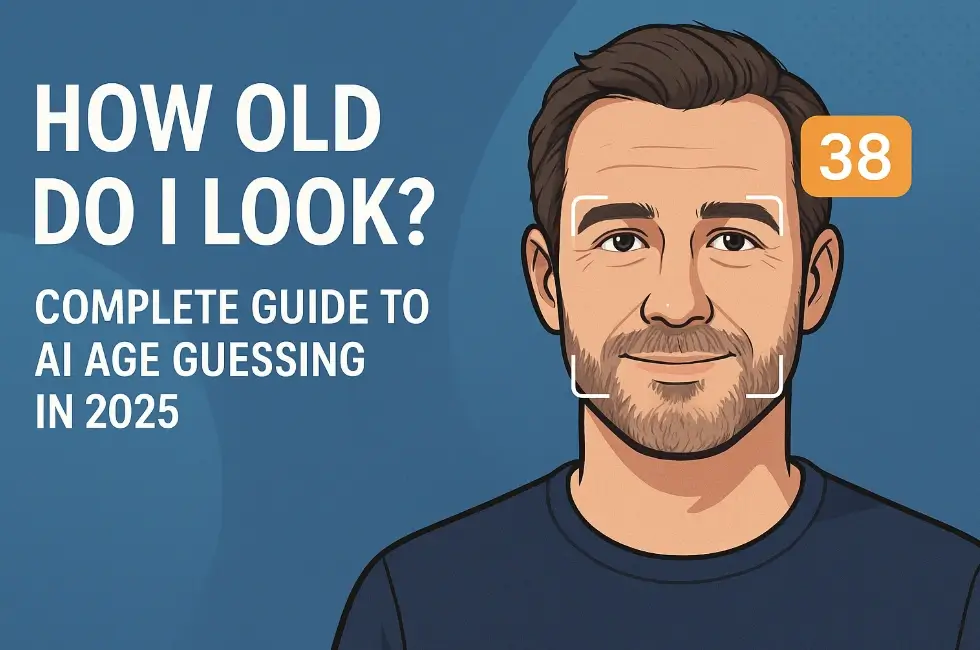
If you search 'how old do I look', you usually want a fast answer to one very human question: what age does my face read as in a photo? AI age guesser tools promise exactly that. You upload an image, wait a moment, and get a predicted age or age range.
That result can be entertaining, but it is also easy to misread. An age detector from a photo does not measure your true biological age, your health, or your value. It estimates apparent age from visible photo cues such as skin texture, facial contours, expression, and the way the image was captured.
This guide explains how AI age guesser tools usually work, how accurate they can be, why some photos make you look older or younger, how to get a fairer result, and what privacy checks matter before you upload your face.
Quick Background
Research on facial age estimation focuses on apparent age, perceived age, and the way visible cues correlate with annotated age labels. A useful overview appears in Nature Scientific Reports.
What an AI Age Guesser Really Measures
An AI age guesser is a software tool that reads one face photo and predicts how old that face appears. In other words, it estimates apparent age, not necessarily your chronological or biological age.
That difference matters. Apparent age can shift because of lighting, fatigue, makeup, skin texture, beard growth, expression, camera distance, and editing. The tool is not peering inside your body. It is reading the visible surface of one image.
The healthiest way to interpret the result is as structured photo feedback. It can tell you how a picture is likely to be read by a model trained on age-labeled faces. It should not tell you how old you are 'supposed' to look.
It rates one image
The prediction comes from a specific photo, not from your face across every real-life situation.
It predicts apparent age
The output reflects how old you look in the image, not your biological health or exact birth age.
It follows training data
Different tools can use different datasets, age buckets, and confidence thresholds.
It has practical uses
It can help compare photos, test lighting setups, or understand how expression changes the way you read on camera.
How AI Age Estimation Usually Works
Most age guesser pages hide the process behind a simple upload button, but the workflow is fairly consistent. The system must first find the face, map important landmarks, extract visible aging cues, and compare those signals with patterns it learned during training.
Some models emphasize facial geometry and texture. Others use deep learning models trained to predict age labels from large image sets. Many modern systems combine multiple signals instead of relying on one rule.
1. Face detection
The model locates the face and separates it from the background, hair, and other distractions.
2. Landmark mapping
It estimates points around the eyes, brows, nose, mouth, jawline, and face outline to understand shape and alignment.
3. Texture and structure reading
The tool reads cues such as skin smoothness, fine lines, under-eye shadows, fullness, and contour changes that often correlate with perceived age.
4. Photo-quality evaluation
Lighting, blur, angle, resolution, and filters affect what the model can confidently see.
5. Age prediction
Finally, the model compares the photo to learned age patterns and returns a number, range, or confidence-weighted estimate.
How Accurate Are AI Age Guessers?
The honest answer is that age guesser accuracy depends on the photo, the model, and the definition of success. For a clear front-facing portrait, a good model may estimate apparent age reasonably well. But that does not mean every predicted number is precise or stable across every image.
Age estimation is usually stronger at broad apparent-age grouping than at exact single-year certainty. A tool might be helpful in telling whether a photo reads younger, older, or around your age range, while still drifting several years between images.
A practical approach is to compare results inside the same tool with similar photos. If three similar portraits land in a close range, the pattern is more useful than one dramatic outlier from one heavily edited selfie.
| What the tool reads | How reliable it can be | What to remember |
|---|---|---|
| Face detection | Usually strong in clear portraits | Heavy shadows, occlusion, and extreme angles reduce confidence quickly. |
| Texture and line cues | Useful but photo-sensitive | Lighting and filters can exaggerate or smooth the same face in different ways. |
| Apparent age range | Moderately useful as a same-tool comparison | A close range is often more meaningful than one exact year number. |
| Cross-app comparison | Weak | Different tools use different models, scales, and age-label assumptions. |
| Biological age inference | Not reliable from a casual selfie | A photo-based age guess should not be treated as a health diagnosis. |
Why Different Photos Can Make You Look Older or Younger
Many people assume a changing age result means the tool is unreliable. Sometimes the tool is simply reacting to different input. A close selfie with overhead light is not the same visual object as a portrait taken at eye level from farther away.
Age estimation models respond strongly to surface cues. Harsh shadows can deepen lines. Beauty filters can smooth texture. A wide smile can change cheek shape and eye creases. Sleepiness, makeup, beard growth, and contrast can all change how old a face appears in a picture.
- Camera distance: Very close selfies can distort central features and make the face read differently than a portrait shot from farther back.
- Lighting: Hard shadows can exaggerate under-eye hollows, smile lines, and texture, making a face read older.
- Expression: Smiles, squints, and tension can create or reduce visible lines and change apparent age.
- Makeup and grooming: Foundation, concealer, beard styling, and hair framing can shift how youthful or mature a face appears.
- Filters and editing: Skin smoothing, sharpening, contrast, and face reshaping can all confuse or alter the output.
- Fatigue and timing: A late-night selfie and a well-rested daylight portrait may look like two different age signals to the model.
How to Run a Fairer 'How Old Do I Look' Test
The best way to use an apparent-age tool is to reduce photo noise. You are not trying to discover a hidden permanent number. You are trying to understand how a model reads a specific image under specific conditions.
Start with a clear front-facing portrait at eye level. Use even light, stand a little farther from the camera, keep your expression relaxed, and avoid strong beauty filters. Then compare two or three similar photos rather than trusting one surprising result.
Photo Checklist for a More Stable Result
- Use a clear front-facing portrait with the camera around eye level.
- Step back slightly instead of using an ultra-close selfie.
- Choose soft, even front light rather than harsh side lighting.
- Keep your expression relaxed and avoid exaggerated tension or posing.
- Avoid heavy filters, skin smoothing, and face reshaping edits.
- Compare similar photos inside the same tool instead of comparing random numbers across different apps.
- If a result surprises you, retest with a cleaner portrait before overinterpreting it.
Privacy Before Uploading Your Face
A face photo is sensitive data. Even if the tool feels playful, you are still uploading an image that may identify you. That does not mean every service is unsafe, but it does mean the privacy policy matters.
Before using any age detector from a photo, check how the service stores files, whether it reuses them for model training, whether another AI provider processes them, and whether you can delete uploads later.
Simple privacy rule
If a tool does not clearly explain what happens to your photo, do not upload an image you would not want stored, reused, or linked back to you.
Storage time
Does the service delete uploads quickly, keep them temporarily, or store them long term?
Training use
Does the product use uploaded photos to improve or train AI models?
Third-party processing
Is the face processed on the product's own system or sent to another provider?
Deletion control
Can you request deletion or remove results from an account?
Account linkage
Is the upload connected to your email, profile, payment, or persistent identifier?
Consent
Do not upload someone else's face, especially a minor's face, without appropriate permission.
Age Guesser vs Face Rating vs Face Symmetry Test
An age guesser, a face rating tool, and a face symmetry test all analyze a face photo, but they answer different questions. Mixing them together can make any one score feel more important than it is.
The useful way to read them is by intent. An age guesser asks how old the face appears in the image. A symmetry tool asks how balanced the left and right sides look. A face rating tool usually blends multiple signals into an overall attractiveness-style score.
| Tool Type | Main question | Best for | Limit |
|---|---|---|---|
| AI age guesser | How old does this face appear in this photo? | Comparing apparent age across similar images | Strongly influenced by photo conditions and model assumptions |
| AI face rating | How does this photo score overall according to the model? | Broader attractiveness-style feedback | More subjective because many signals are blended into one score |
| Face symmetry test | How balanced are the left and right sides? | Understanding alignment and angle effects | Symmetry does not answer apparent age |
| Facial harmony guide | How do features work together proportionally? | Reading structure and overall balance | Harmony standards vary by model and interpretation |
Research, Bias, and Real Limits
Apparent-age estimation is an active research area, but even strong models still depend on training data and image conditions. They can learn useful age-related patterns without becoming perfect judges of how old every face 'really' looks.
Bias also matters. If training data is narrow or uneven, the result may be less stable across skin tones, age groups, and image styles. That is one reason the output should be treated as a model prediction, not objective truth.
The safest summary is this: AI age guessers can apply their learned pattern consistently enough to be useful as photo feedback, but they do not replace human context, identity, or privacy judgment.
- Apparent age estimation review: A broad research article discusses apparent age prediction and the role of deep learning in age estimation from facial images. Scientific Reports.
- Perceived age and health cues: Research on perceived age helps explain why visible skin and facial cues can shape how old a face appears. PubMed.
- Face AI and demographic performance: NIST reporting on face AI reminds readers that model performance can vary across demographic conditions. NIST FRVT demographics.
- Biometric privacy warning: The FTC warns that misuse of biometric information can create privacy, security, and discrimination risks. FTC biometric information warning.
Final Thoughts
If you ask 'how old do I look', an AI age guesser can give you a useful answer in one narrow sense: how old your face appears in one image according to that model. That can be interesting, practical, and even helpful when you are comparing similar photos.
The trouble begins when a predicted age becomes a verdict about your health, beauty, or identity. Apparent age is only one reading of one picture. Use it for context, not for self-worth.
For the best result, use a clean portrait, compare similar images, read the privacy terms, and keep age estimation in the same bucket as other photo-based tools: informative in context, limited on its own.
Treat apparent age as a photo-reading signal
The most useful pattern is to compare similar images and look for what changes the result, not to obsess over one number from one selfie.
Try AI Face Rating