Facial Thirds: What They Are, How to Measure Them, and How to Read the Result
A practical guide to the upper, middle, and lower thirds of the face, with photo checks, examples, and calm limits for interpreting one proportion.
Clara Bennett
Editor focused on facial symmetry, proportion, and photo-based analysis.
Clara writes practical explainers that separate repeatable photo measurements from broad beauty claims. Her goal is to help readers understand a result without turning one number into a verdict.
Facial thirds are a descriptive proportion reference, not a universal beauty rule or a medical test.
Facial thirds are a simple way to describe the vertical structure of a face. The upper third runs from the visible hairline to the brow line, the middle third runs from the brow line to the base of the nose, and the lower third runs from the base of the nose to the bottom of the chin. People usually look up facial thirds because they want to understand a face proportions test, compare a portrait, or make sense of a facial thirds calculator.
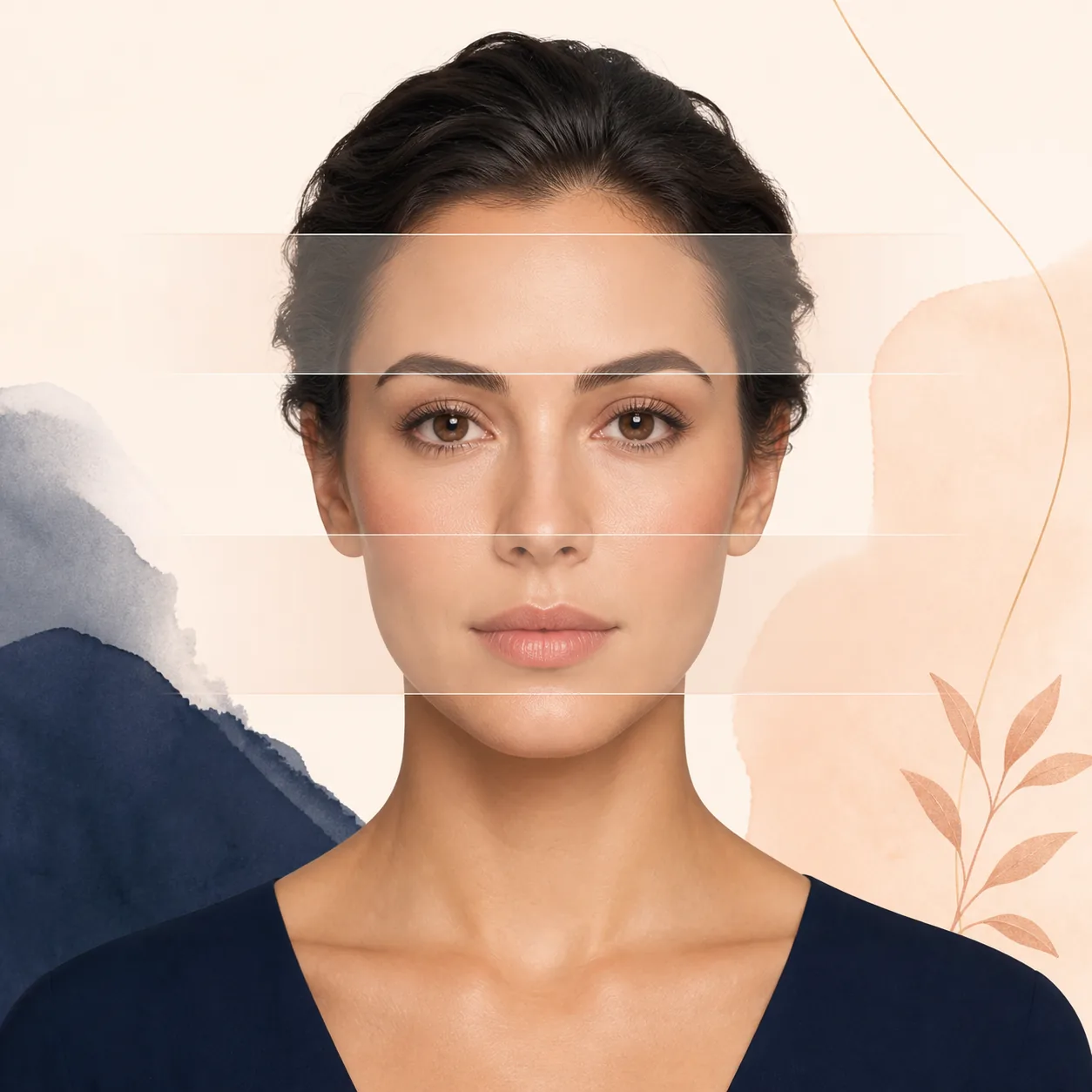
The useful part is the measurement framework, not the idea that every face should match a perfect template. Natural faces vary with age, ancestry, hairstyle, expression, head position, and camera distance. A careful facial thirds check can explain what a photo shows, but it cannot decide whether a face is attractive, healthy, or objectively balanced.
This guide focuses on the questions behind the search: where the thirds are, how to measure them fairly, how to read examples such as 33 / 33 / 34, and when to use the dedicated Facial Thirds Test for a quick calculation.
Quick answer
Measure hairline to brow, brow to nose base, and nose base to chin using the same unit and a straight, front-facing photo. Convert each segment into a percentage of the total. A result near 33.3% / 33.3% / 33.3% is close to the traditional 1:1:1 reference, but small differences are normal and photo setup can change the reading.
What are facial thirds?
The phrase facial thirds refers to three vertical sections measured down the front of the face. The upper third is usually estimated from the hairline to the brow line. The middle third runs from the brow line to the base of the nose. The lower third runs from the base of the nose to the lowest point of the chin. The exact landmarks may be described slightly differently, especially when the hairline is hidden, but the goal is always the same: compare three vertical distances on one face.
Facial thirds are one part of facial proportions. They do not describe eye spacing, nose width, mouth width, jaw width, left-right symmetry, skin, expression, or the way a face reads as a whole. That is why a facial thirds result can look close to 1:1:1 while a symmetry test or facial harmony guide answers a different question.
The word ideal is often used around this topic, but it needs care. A traditional reference can help organize a measurement; it does not prove that a small deviation is a flaw. The most useful interpretation is descriptive: which segment measured longer in this photo, by how much, and could the image setup have caused part of the difference?
Upper third
Hairline to brow line. A covered or uneven hairline makes this the least certain segment.
Middle third
Brow line to the base of the nose. Head tilt and nose angle can change the visible distance.
Lower third
Base of the nose to the bottom of the chin. Lips, jaw tension, and chin position can affect the reading.
Whole-face context
The three numbers describe vertical proportion only, so interpret them alongside the photo and the reader's actual question.
How to measure facial thirds
You do not need a special unit to measure facial thirds. A ruler, image editor, or pixel tool can work. The important rule is consistency: use the same scale, keep the face in one image, and mark comparable landmarks. If the photo is not straight, the measurement may reflect the camera more than the face.
For a simple manual check, use a neutral front-facing portrait. Keep the camera near eye level, move it farther away rather than relying on a close wide-angle selfie, and crop later if needed. Turn off beauty filters and avoid a strong side light. The goal is not to create a perfect portrait; it is to reduce avoidable variables before comparing the three segments.
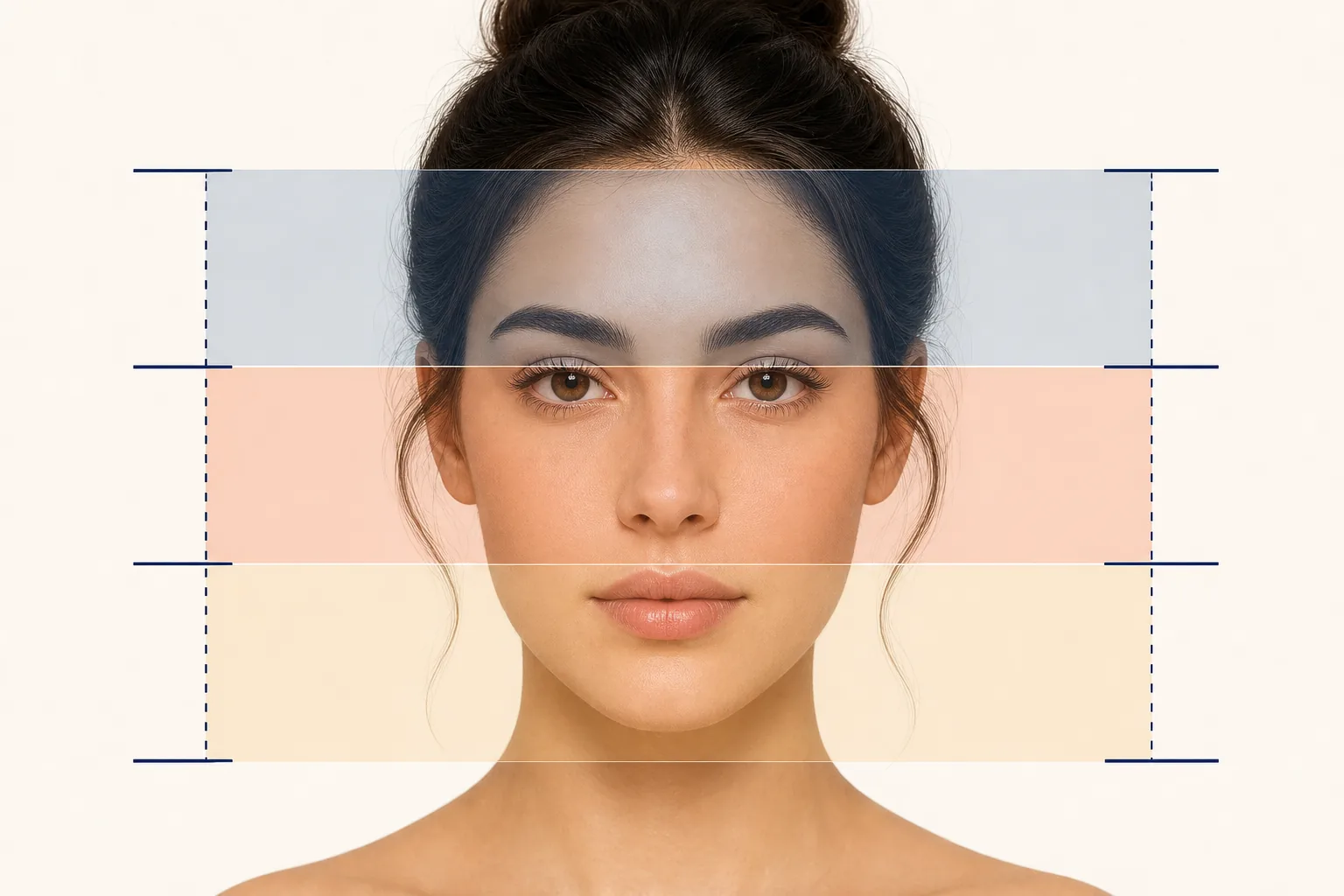
- Choose a repeatable photo
Use a relaxed expression, level head, eye-level camera, moderate distance, even light, and visible landmarks. - Mark four landmarks
Mark the visible hairline, brow line, base of the nose, and bottom of the chin. If a landmark is hidden, record that the segment is an estimate. - Measure with one scale
Measure hairline to brow, brow to nose base, and nose base to chin in pixels, millimeters, or another consistent unit. - Convert to percentages
Add the three measurements for total face height, then divide each segment by that total and multiply by 100. - Repeat before concluding
Use two or three similar photos. A pattern that repeats is more useful than one result from a tilted or filtered image.
How to read a facial thirds ratio
A calculator may show raw measurements, percentages, or a summary label. Percentages make comparisons easier because the total face height becomes 100%. If the upper, middle, and lower segments are 32, 33, and 35 units, the percentages are about 32%, 33%, and 35%. That is a way to describe the photograph; it is not a pass-or-fail grade.
The familiar 1:1:1 reference means the three segments are equal in a simplified model. It is useful as a baseline because it gives the reader a common point of comparison, but it should not be treated as an objective requirement. Hairline visibility, camera angle, expression, and the choice of landmarks can easily move a percentage by a few points.
| Example | What it suggests | Best next step |
|---|---|---|
| 33 / 33 / 34 | Very close to the 1:1:1 reference in this measurement. | Keep the result in context and compare similar photos. |
| 29 / 36 / 35 | The middle and lower thirds read longer than the upper third. | Check hairline visibility, camera distance, and head tilt. |
| 35 / 31 / 34 | The middle third reads a little shorter than the other two. | Confirm the brow and nose-base landmarks before interpreting it. |
| 31 / 32 / 37 | The lower third is the dominant section in this image. | Repeat with relaxed lips and a level chin. |
Photo conditions that can change the result
If two photos produce different facial thirds, do not assume that your face changed. The camera can change the visible geometry. A close phone camera, a tilted head, or a low angle may stretch one area or hide another. A smile, pursed lips, or a tucked chin also changes where a measurement appears to end.
This is why a fair facial thirds test is closer to a small measurement experiment than a selfie filter. Keep the process repeatable, note what changed, and avoid comparing a casual close-up with a distant portrait taken using a different lens.
- Wide-angle distance: A close selfie can exaggerate central features and change the apparent length of the midface.
- Head tilt: Even a small tilt changes horizontal reference lines and can compress one side of the measurement.
- Hidden hairline: A fringe, hat, or cropped frame makes the upper third an estimate rather than a direct measurement.
- Expression: Smiling, opening the mouth, or tightening the jaw can move the visible lower endpoint.
- Lighting and shadows: Strong side light can make the nose, brow, or chin boundary look farther forward or backward.
Facial thirds vs other face-analysis tools
Searches for facial thirds overlap with facial proportions, facial harmony, golden ratio, and face symmetry. These topics are related, but they are not interchangeable. Choosing the tool that matches the question keeps the result easier to understand and reduces the temptation to treat several unrelated scores as one overall rating.
Use the Facial Thirds Test when you want a simple vertical comparison. Use a face symmetry test when you want to compare left and right balance. Use a golden ratio calculator for selected ratio references, and use a facial harmony guide when you want a broader explanation of how spacing, expression, proportion, and photo conditions work together.
| Tool or topic | Question it answers | Best for | Limit |
|---|---|---|---|
| Facial thirds test | How do upper, middle, and lower face lengths compare? | Vertical proportion and measurement practice | Does not measure symmetry or total attractiveness |
| Face symmetry test | How similar do the left and right sides look? | Bilateral balance in a photo | Does not explain vertical thirds |
| Golden ratio face test | How do selected distances compare with a ratio reference? | Exploring proportion formulas | A ratio reference is not a universal beauty standard |
| Facial harmony guide | How do several visible features work together? | Whole-face context and interpretation | Broader context is less like one simple measurement |
How to interpret your result without overreading it
Start with the largest difference, then ask whether the photograph could explain it. A two-point gap from 33.3% may be less meaningful than a small gap that repeats across several carefully matched images. Conversely, a dramatic result from one close selfie may say more about the lens or the landmarks than about stable facial structure.
It is also helpful to keep the language neutral. Instead of saying that one third is wrong, say that it measured longer in this image. Instead of chasing a perfect ratio, ask whether the result helps you compare photos, understand a tool, or decide what information you actually wanted.
A calm reading checklist
- Check the image first: distance, angle, light, expression, and hairline.
- Compare percentages, not only the label shown by a calculator.
- Repeat the measurement with similar photos before making a broad claim.
- Use the face symmetry test for left-right balance instead of asking thirds to answer every question.
- Treat 1:1:1 as a reference point, not a requirement for a balanced or attractive face.
Limits, privacy, and responsible use
Facial thirds are an educational way to describe a photo. They cannot diagnose a condition, predict attractiveness, identify a cause of facial change, or tell you what treatment you need. If you are worried about a sudden change, pain, swelling, weakness, numbness, or a functional problem, a ratio calculator is the wrong tool for that question; seek appropriate professional advice.
Privacy matters as well. Only upload a face photo when you understand how the tool handles it and when you have permission to use the image. Do not measure another person, especially a minor, without consent. For simple learning, a local ruler or a crop of a photo may be enough; you do not need to turn every observation into a permanent score.
Photo estimate
The result depends on the image, landmarks, lens, angle, expression, and visible hairline.
One proportion
Facial thirds do not cover symmetry, eye spacing, face shape, skin, expression, or overall harmony.
Consent first
Use other people's images only with permission, and avoid uploading sensitive or identifying photos unnecessarily.
Final takeaway
Facial thirds give you a clear vocabulary for three vertical face measurements: upper, middle, and lower. The most reliable process is simple—use a front-facing photo, mark consistent landmarks, measure with one scale, convert to percentages, and repeat before drawing conclusions.
A result near 1:1:1 can be close to the traditional reference, while a different ratio can still be completely natural. Use the numbers to understand a photo and choose the right next question, not to reduce a real face to a score.
Use the calculator as a starting point
A quick calculation is most useful when you pair it with a repeatable photo and a clear understanding of what the three numbers represent.
Try the Facial Thirds Test