What is facial harmony? In plain language, it is the way a face reads as a coordinated whole. Eyes, brows, nose, lips, cheeks, jaw, forehead, skin, expression, and profile do not work as isolated pieces. Their size, spacing, direction, and visual weight interact. A face can therefore feel balanced even when no single feature matches a textbook ideal.
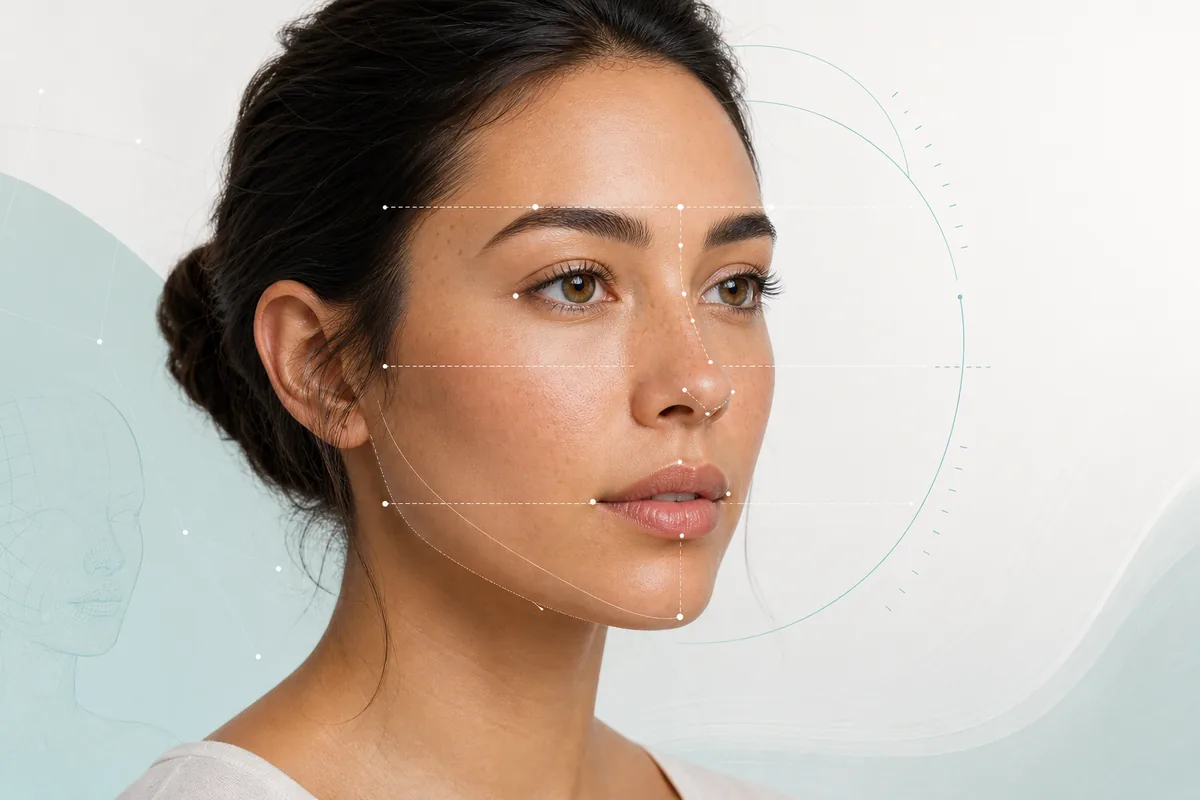
That answer is different from a facial harmony test or facial harmony score. A test is a method for looking at a photograph; a score is a model's summary of that photograph. This definition page stays with the concept itself. Our existing Facial Harmony Guide covers photo setup, measurement ideas, and tool selection, while the Face Symmetry Test focuses on left-right alignment.
The distinction matters because the word harmony is often used in cosmetic marketing, social posts, and AI reports as if it were one objective number. A more useful reading treats it as a description of relationships: how features support one another, how an expression changes the impression, and how the camera can exaggerate or soften visible differences.
Background
Research reviews describe facial attractiveness as multi-factorial, with symmetry, averageness, proportions, skin cues, culture, and individual preference interacting rather than one rule deciding the result. See the NCBI/PMC review.
What Is Facial Harmony?
Facial harmony is a whole-face impression created by relationships among features. It includes proportion, spacing, alignment, contour, expression, and the way the face is presented. The idea is closer to composition than to a pass-or-fail measurement: a nose, chin, or pair of eyes is read in relation to everything around it.
Harmony does not require identical halves or conventionally small features. A strong nose can work with a strong chin; a round face can feel coherent without a sharp jaw; an uneven smile can still fit a person's expression. The useful question is not whether a feature is perfect, but whether the parts support a recognizable and balanced whole.
- Whole-face balance: The impression comes from several features working together, not from the most noticeable feature alone.
- Proportion: Relative size and distance help the eyes, nose, mouth, cheeks, and jaw read as one structure.
- Visual rhythm: Repeated lines, curves, and transitions can make a face feel coherent even when it is distinctive.
- Context: Expression, lighting, lens distance, hairstyle, and viewing angle change how relationships appear.
Harmony Is a Relationship, Not a Perfect Feature
When people say that a face looks harmonious, they are usually describing how easily the features make sense together. This does not mean the viewer is performing a precise calculation. Human perception notices patterns quickly, then combines structure with expression, familiarity, styling, and social context.
A single feature can attract attention without disrupting harmony. In fact, memorable faces often have a feature that is unusual or prominent. The surrounding features, the person's expression, and the overall contour can make that feature feel intentional rather than disconnected. That is why copying a ratio or isolating one area rarely explains the whole impression.
- Distinctive is not defective: A feature can stand out and still belong to the overall composition.
- Balance is contextual: The same nose-to-chin relationship can read differently in profile, in a smile, or under a wide-angle lens.
- Perception is variable: Different viewers and cultures can prefer different patterns of proportion and expression.
- A ratio is a reference: Golden-ratio or thirds references can organize a discussion, but they cannot define a person's value.
Facial Harmony vs Facial Symmetry
Facial symmetry asks a narrower question: how closely do the left and right sides align around a center line? A symmetry check can compare eye height, brow position, nostril width, mouth corners, or jaw contours. Those observations are useful, but they describe bilateral matching rather than the full relationship among features.
Facial harmony includes symmetry as one signal and then adds proportion, spacing, contour, expression, and context. A mildly asymmetrical face may still feel coherent. Conversely, a highly symmetrical face can feel less balanced if the size or projection of its features does not work together.
| Concept | Main question | Limit |
|---|---|---|
| Facial harmony | Do the features support a coherent whole-face impression? | Depends on context, perception, and the image used. |
| Facial symmetry | How evenly do the left and right sides align? | It is one dimension of a face, not a complete beauty measure. |
| Facial proportions | How do selected distances and regions relate in size? | Camera angle and chosen landmarks can change the reading. |
| Facial harmony score | How does a particular model summarize one photo? | Weights, training data, expression, and lighting affect the output. |
Facial Harmony vs Attractiveness and Beauty
Harmony and attractiveness overlap, but they are not synonyms. Harmony describes a pattern of relationships. Attractiveness is a broader judgment that can include expression, movement, grooming, voice, familiarity, personality, culture, and personal preference. A photo-based AI face rater may compress some visible cues into an attractiveness score, but the number cannot capture everything people respond to in real life.
This boundary is especially important when an article or tool uses words such as ideal, perfect, or objective. Those words can turn a descriptive idea into a value judgment. A careful explanation says what was observed, what was inferred, and what the image cannot show.
- Harmony: A visual description of how features relate.
- Attractiveness: A wider, personal and cultural response that includes more than geometry.
- Beauty standard: A social or cultural preference that can change across people, places, and time.
What Shapes a Harmonious Impression?
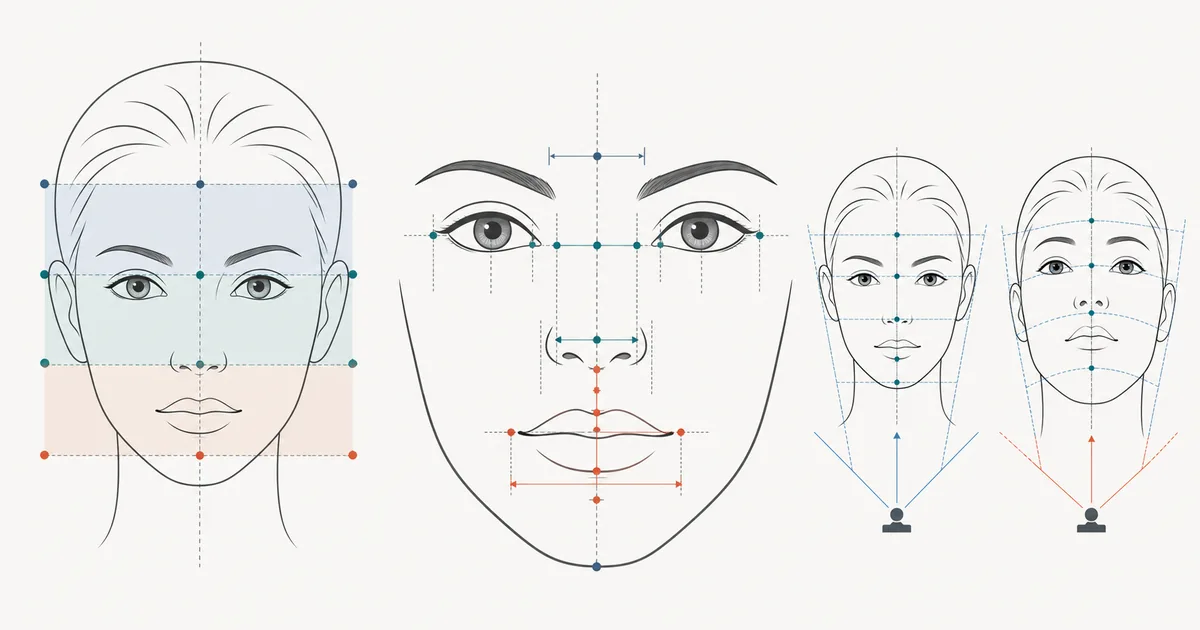
There is no universal checklist, but several relationships commonly appear when people explain facial harmony. Facial thirds describe the upper, middle, and lower regions. Eye spacing, brow direction, nose projection, lip position, chin support, and jaw contour describe how the center and lower face connect. These are useful vocabulary, not instructions to change a face.
The photograph adds another layer. A close selfie can enlarge the nose and center of the face; side lighting can deepen one cheek; a tense mouth can change the lower-face rhythm; a turned head can make the jaw appear uneven. Any interpretation should separate a possible structural pattern from a temporary image effect.
- Facial thirds: Upper, middle, and lower regions can create a sense of vertical proportion, with natural variation expected.
- Feature spacing: The distance among eyes, nose, mouth, and jaw affects visual rhythm in a front-facing image.
- Profile relationships: Nose, lips, chin, and forehead projection interact in side view; one line cannot describe the whole face.
- Expression: Relaxation, smiling, and tension can shift the perceived balance of the same structure.
- Camera geometry: Lens distance, crop, angle, and mirroring can exaggerate small differences.
- Surface and styling: Lighting, skin texture, hair, glasses, and makeup influence what the eye notices first.
What a Facial Harmony Score Can and Cannot Say
A facial harmony score is usually a summary of selected image measurements or model-learned patterns. It can be useful when the tool explains its inputs and lets you compare similar photos. It becomes misleading when the page presents a single number as an objective ranking of a person.
Scores also vary because tools use different landmarks, weights, datasets, thresholds, and labels. A change between two photos may reflect lighting, expression, crop, or detection quality rather than a change in your face. Treat a repeated pattern as more informative than one result, and read the explanation before reacting to the number.
- It can say: How a particular tool summarized visible relationships in one image.
- It cannot say: How attractive, healthy, worthy, or likable a person is in real life.
- Why it changes: Photo setup, expression, detection, model weights, and dataset assumptions can all shift the result.
- How to use it: Compare similar images, look for explanations, and keep the result in context.
How to Read Online Harmony Claims Responsibly
If you use a facial harmony analysis page, start by checking what it actually measures. A reliable explanation names the input, the output, the photo conditions, and the uncertainty. Be cautious when a page hides the method, promises an objective beauty ranking, or uses shame to push a product.
Privacy is part of the same decision. A face photo can identify you even when the result feels like a casual quiz. Before uploading, look for storage duration, model-training use, third-party processing, account linkage, deletion controls, and a clear privacy policy. Do not upload another person's image without permission, especially a child's.
- Check the scope: Does the page discuss symmetry, proportions, expression, photo quality, or a mixture?
- Check the evidence: Are limitations and sources visible, or is the score presented as self-evident?
- Check the photo: Use a clear, neutral image and avoid treating a close selfie or filter as a stable baseline.
- Check privacy: Understand storage, training, providers, account links, and deletion before upload.
- Check your reaction: A result that increases distress is a reason to pause, not to chase more scores.
A Practical Takeaway
So, what is facial harmony? It is a way to describe how facial features relate as a whole: proportion, spacing, symmetry, contour, expression, and context working together. The concept can help explain why a face feels coherent without requiring every feature to match one ideal.
Use the definition as a boundary. For measurement steps, read the Facial Harmony Guide; for a left-right comparison, use the Face Symmetry Test; for a wider model-based rating, read the AI Face Rater Guide. Each tool answers a different question. Keeping those questions separate makes the result easier to understand and less personal than a single beauty score.
FAQ About Facial Harmony
A face is a relationship, not a checklist
Use proportions and symmetry as useful descriptions, then leave room for expression, lighting, culture, and individual variation.