Asymmetrical Jaw: 7 Causes, Checks, and Safe Next Steps
A calm guide to uneven jawlines, bite and muscle clues, photo distortion, treatment pathways, and the symptoms that should not be treated as a cosmetic problem.
Clara Bennett
Beauty-tech writer covering face analysis, self-image, and practical AI tools.
Clara writes grounded explainers about facial analysis technology and helps readers separate photo effects from questions that belong with qualified dental or medical professionals.
This article is general information, not a diagnosis or treatment plan. A photo or symmetry score cannot assess your bite, jaw joint, bone growth, nerve function, or the cause of a sudden change.
An asymmetrical jaw means the lower face looks different on the left and right. One jaw angle may seem wider, the chin may sit slightly off center, or one side may look longer in photos. Mild, stable differences are common. The useful question is not whether the jaw is perfectly mirrored, but whether the difference is photographic, muscular, dental, skeletal, or new and symptomatic.
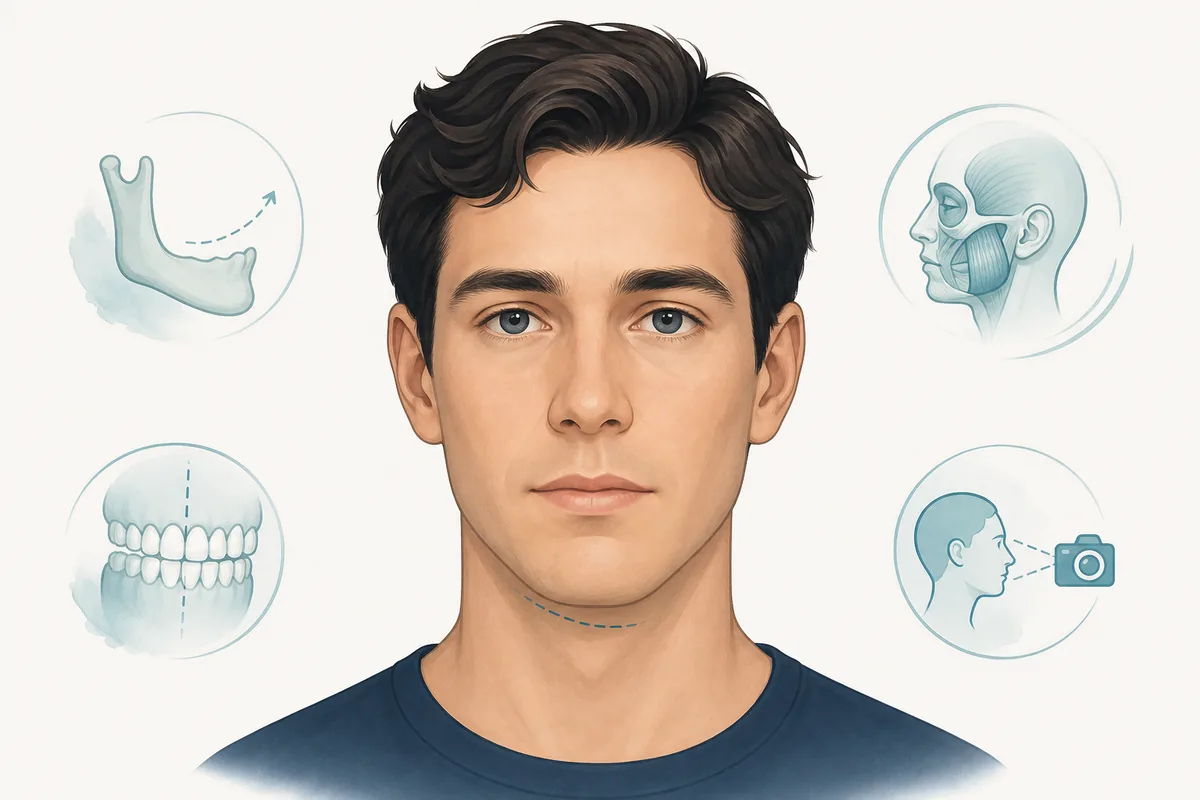
An uneven jawline cannot be diagnosed from a selfie. A close phone lens, a small head turn, side lighting, facial tension, or a smile can change the apparent width and height of each side. If the same pattern remains in neutral photos and comes with bite changes, jaw pain, clicking, locking, chewing trouble, or progressive change, a dentist, orthodontist, or oral and maxillofacial specialist can examine what a photo cannot.
This guide separates low-risk photo checks from functional clues and professional treatment pathways. It also explains why braces, exercises, injections, or surgery are not interchangeable fixes: each addresses a different cause, and some options are inappropriate without an examination.
Evidence Note
A clinical overview of facial asymmetry, including uneven jawline assessment and function, is available from Penn Medicine.
What Does an Asymmetrical Jaw Mean?
Jaw asymmetry is a visible or measurable left-right difference involving the mandible, chin, jaw angles, dental midline, bite, chewing muscles, or surrounding soft tissue. An asymmetrical jawline may be mostly cosmetic, mostly functional, or a combination. The outside contour does not reveal which tissue is responsible.
A stable jaw that has looked similar for years is different from a jaw that recently shifted, swelled, became painful, or started deviating during opening. Timing, function, and progression matter more than a single symmetry percentage.
Contour difference
One jaw angle or side of the lower face looks broader, sharper, or lower.
Chin or midline shift
The chin point or lower dental midline sits to one side of the facial center.
Movement difference
The jaw deviates, clicks, locks, or feels painful while opening and chewing.
Photo-only difference
The imbalance changes substantially with distance, angle, light, or expression.
Seven Common Causes of an Asymmetrical Jaw
More than one factor may be present. A fair assessment separates what can change with a better photo from what needs a dental or medical examination. Online claims that blame one habit for every uneven jaw are too simple.
1. Normal growth variation
The two sides of the mandible and surrounding soft tissue rarely develop as perfect mirror images. A small stable difference may be ordinary anatomy.
2. Camera, head position, and expression
A close wide-angle lens, head rotation, side light, or uneven smile can magnify one jaw angle without changing the underlying structure.
3. Dental midline or bite differences
Crossbite, tooth position, missing teeth, or a functional shift when the teeth meet can make the chin and lower jaw appear off center.
4. Chewing-muscle imbalance
Clenching, grinding, or consistently loading one side may change muscle bulk or tenderness, but appearance alone cannot prove the habit caused the asymmetry.
5. Jaw-joint problems
TMJ pain, clicking, restricted opening, or deviation may occur with joint or muscle disorders and should be assessed when persistent.
6. Skeletal growth or past injury
Uneven jaw growth, developmental conditions, or a healed fracture can create a structural difference that requires imaging to characterize.
7. New swelling or neurological change
Rapid swelling, new weakness, numbness, drooping, or speech trouble is not a beauty-tool issue and needs appropriate medical attention.
What Different Clues Can—and Cannot—Tell You
A mirror or photo can show a repeated visual pattern, but it cannot test the bite, palpate muscles, assess joint movement, or distinguish bone from soft tissue. A symmetry tool is useful only for standardizing images and noticing whether the apparent difference is stable across comparable photos.
Functional information is more actionable than a number. Note whether your teeth meet differently, the jaw shifts while opening, one side is painful, chewing is difficult, or the pattern is getting stronger. Those observations help a professional choose an examination; they do not create a diagnosis by themselves.
| Clue | What it may suggest | What it cannot prove |
|---|---|---|
| Changes with camera angle | Photo geometry is contributing | That the underlying jaw is perfectly even |
| Dental midlines do not match | A bite or tooth-position question | Whether the cause is dental or skeletal |
| Jaw deviates while opening | A movement pattern worth describing | A specific TMJ diagnosis |
| One side is painful or locks | Function needs assessment | Which treatment is appropriate |
| Stable difference for years | Long-standing variation | That no dental issue exists |
How to Check an Uneven Jawline More Fairly
Take a neutral front-facing portrait at eye level. Step back and crop later rather than holding the phone close. Use even front light, keep the ears and shoulders level, relax the lips and jaw, and avoid portrait reshaping or beauty filters. Repeat the same setup twice instead of comparing unrelated selfies.
Then compare rest and gentle movement. Without forcing the jaw, notice whether the chin stays centered as the mouth opens, whether there is pain or locking, and whether the bite feels different from usual. Stop if movement hurts. This is an observation step, not a home diagnostic test.
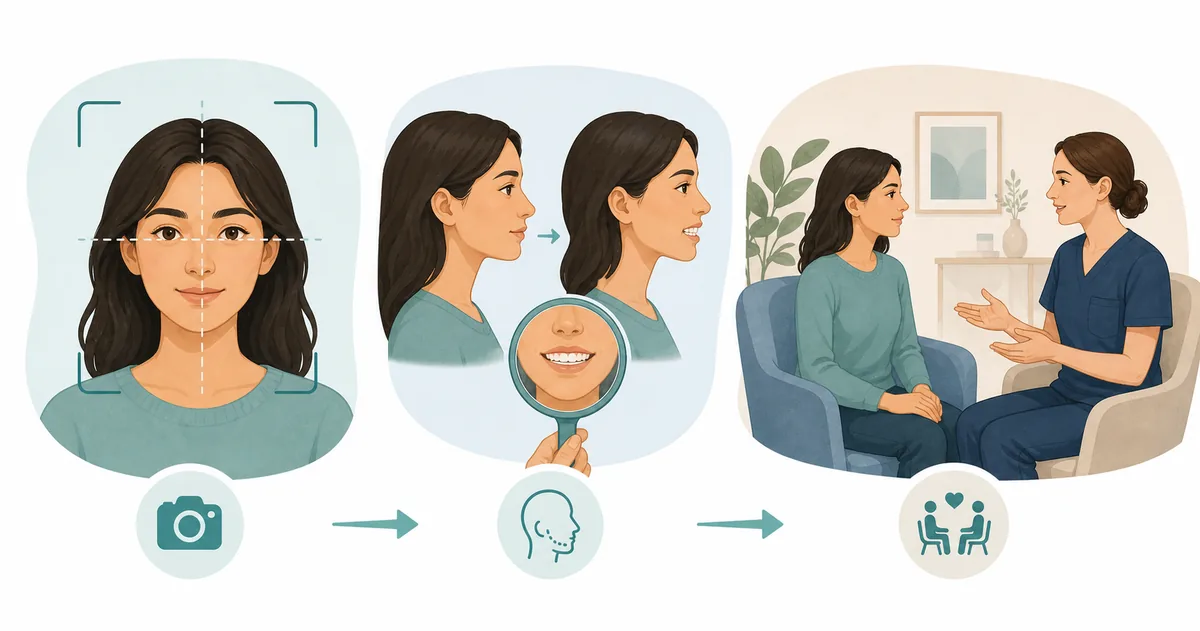
- Distance: Move the camera farther away to reduce wide-angle distortion.
- Alignment: Keep the lens, eyes, nose, chin, shoulders, and head level.
- Lighting: Use soft front light so side shadows do not reshape the jawline.
- Expression: Relax clenching, lips, brows, and smile before comparing sides.
- Repeatability: Look for the same pattern in two or three comparable photos.
- Function: Record pain, clicking, locking, bite change, or restricted movement.
When an Uneven Jaw Needs Professional or Urgent Care
Arrange dental or medical assessment when jaw asymmetry is new or progressing, or when it comes with persistent pain, swelling, locking, a changed bite, difficulty chewing, restricted opening, trauma, or a lump. A dentist may start the evaluation and refer to orthodontics, oral medicine, TMJ care, or oral and maxillofacial surgery when needed.
Seek prompt medical help for sudden facial drooping, numbness, weakness, speech trouble, arm weakness, confusion, severe headache, or difficulty closing one eye. Those symptoms should not wait for an online symmetry result.
Do not rely on a photo alone if you notice
- Sudden one-sided facial drooping, numbness, or weakness
- Speech trouble, arm weakness, confusion, or a severe new headache
- Jaw injury, rapidly increasing swelling, fever, or a new lump
- Persistent pain, locking, limited opening, or trouble eating
- A bite or chin position that is clearly changing over time
Which Professional Should Assess Jaw Asymmetry?
Start with the main symptom rather than choosing a procedure. Tooth contact and bite concerns often begin with a dentist or orthodontist. Persistent joint pain, locking, or movement limits may need a dentist with TMJ or oral-medicine expertise. A clear skeletal difference, injury history, or significant functional problem may lead to an oral and maxillofacial surgeon.
Cosmetic clinicians can discuss soft-tissue or muscle-volume options, but they should not replace dental or skeletal assessment when the bite, joint, or bone may be involved. Bring repeatable photos and a short timeline of symptoms.
-
Dentist
Tooth wear, missing teeth, bite change, grinding, pain, or a first oral examination. -
Orthodontist
Dental midline, crossbite, tooth alignment, or growth-related bite questions. -
TMJ or oral-medicine clinician
Persistent joint pain, clicking with symptoms, locking, or restricted opening. -
Oral and maxillofacial surgeon
Skeletal asymmetry, significant functional problems, trauma, or surgical assessment. -
Medical or emergency care
Sudden weakness, numbness, drooping, speech change, severe swelling, or acute injury.
Braces, Exercises, Injections, and Surgery: Different Jobs
Treatment depends on the cause, severity, symptoms, age, and goals. Braces move teeth; they do not automatically make uneven jaw bones symmetrical. Exercises may be appropriate in a clinician-guided rehabilitation plan, but cannot reliably remodel an adult jaw. Injections can change muscle activity or soft-tissue contour in selected cases, while orthognathic surgery repositions jaw bones for specific skeletal and functional problems.
The safest choice is the least invasive option that matches a verified cause. A photo score cannot select that option or predict the result.
| Path | Best matched to | First step | Key limit |
|---|---|---|---|
| Photo correction | Lens, pose, light, expression | Repeat a neutral portrait | Does not change anatomy |
| Orthodontic care | Teeth, dental midline, selected bite problems | Dental and orthodontic exam | Cannot correct every skeletal difference |
| TMJ or muscle care | Pain, locking, tension, movement limits | Cause-based conservative assessment | Not a universal cosmetic fix |
| Cosmetic treatment | Selected soft-tissue or muscle-volume differences | Qualified individualized consultation | May mask rather than correct structure |
| Orthognathic surgery | Selected skeletal and functional jaw problems | Orthodontic and maxillofacial planning | Major treatment with risks and recovery |
Be Careful With Exercises and Online Fix Claims
Claims that one-sided chewing, sleeping position, posture, or tongue exercises explain every asymmetrical jaw often go beyond the evidence. Habits can affect muscle tension and presentation, but a visible contour cannot prove the cause. Do not force jaw movement, chew excessively on one side, or begin painful exercises to chase symmetry.
If you upload face photos, review storage, deletion, training, and third-party processing policies. Avoid uploading medical images, children's photos, or someone else's face without consent.
Safety rule
Stop any self-directed jaw exercise that causes pain, locking, dizziness, or worsening symptoms, and seek professional guidance.
No universal exercise
Muscle, joint, dental, and bone causes do not respond to the same routine.
No forced one-side chewing
Overloading one side is not a safe method for balancing the jaw.
No treatment from a score
A symmetry percentage cannot prescribe braces, injections, or surgery.
Protect photo privacy
Use services that clearly explain retention, deletion, and data use.
Research, Sources, and Important Limits
Clinical sources agree on one central point: facial and jaw asymmetry can arise from dental, skeletal, muscular, developmental, joint, trauma-related, or soft-tissue factors. Appropriate treatment follows examination of the cause and function, not appearance alone.
This page cannot tell whether an individual has a jaw disorder. It offers a structured way to improve photo quality, record useful symptoms, and choose a sensible starting point for care.
- Facial asymmetry overview: Explains causes, examination, and uneven jawline considerations. Penn Medicine.
- Jaw surgery overview: Explains that orthognathic surgery addresses selected crooked or uneven jaw-bone conditions through specialist planning. Mayo Clinic.
- Stroke warning signs: Lists sudden face drooping, arm weakness, and speech difficulty as warning signs requiring urgent action. CDC.
Practical Takeaway
An asymmetrical jaw is not one diagnosis and does not have one fix. First remove camera distortion with a repeatable portrait. Then pay attention to function, timing, and progression. A small stable uneven jawline without symptoms may simply be normal variation; pain, locking, bite changes, trauma, or progression deserves assessment.
Choose a professional by the problem: dentist or orthodontist for teeth and bite, TMJ or oral-medicine care for persistent joint symptoms, oral and maxillofacial expertise for skeletal or major functional concerns, and prompt medical care for sudden neurological changes.
Use the face symmetry test to compare photos, not to diagnose a jaw condition or choose treatment. The goal is better context and a safer next step, not a perfectly mirrored face.
Use a score as context, not a treatment decision
Compare several fair photos. If the concern involves pain, bite, movement, or a recent change, take those details to the appropriate professional.
Try the Face Symmetry Test