Face Symmetry Exercises: What They Can and Cannot Change
A careful guide to facial exercises, muscle tension, photo posture, realistic expectations, and the signs that should not be treated as a beauty problem.
Written by Clara Bennett
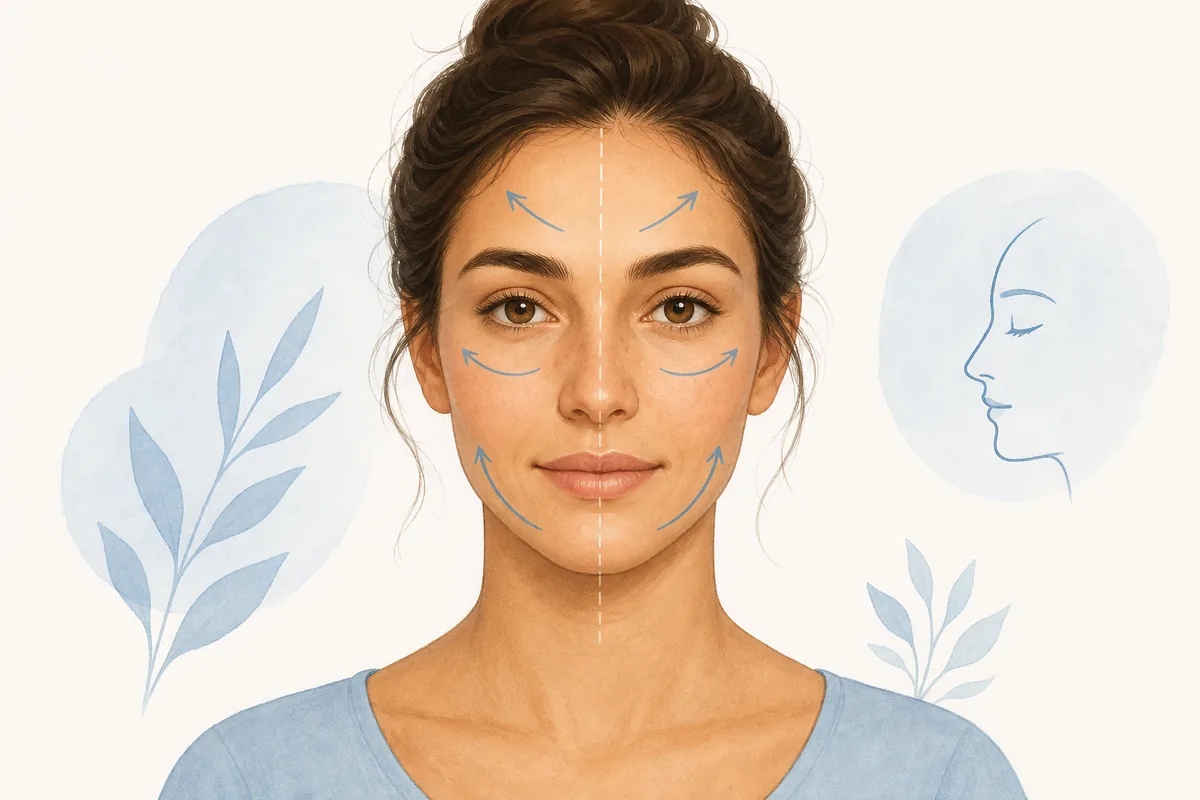
The short answer
Face symmetry exercises can be reasonable as gentle relaxation, movement-awareness, or photo-preparation habits. They may change how tense or expressive a face looks for a short time, but there is not good evidence that ordinary home exercises can reliably move facial bones, change a dental bite, or permanently correct structural asymmetry. Stop if an exercise causes pain, jaw clicking, numbness, weakness, or a worsening change.
Searching for face symmetry exercises usually means you want a practical way to make one side of the face look less tense, less droopy, or less noticeable in photos. That is a reasonable question, but the word exercise covers several very different goals: relaxing an overworked muscle, improving posture, rehearsing a neutral expression, or trying to change a structural difference.
Those goals should not be treated as interchangeable. A mirror, selfie, or AI face symmetry score can make a small difference look dramatic, while an exercise may briefly change muscle tension or expression without changing the underlying shape. This guide separates the low-risk things you can observe from promises that deserve skepticism.
The safest approach is to use a gentle routine as an observation tool, not a test of discipline or a promise of beauty. Pair it with a repeatable photo setup, track timing and symptoms, and choose dental or medical advice when the pattern involves function, sudden weakness, pain, swelling, or a new change.
What can face symmetry exercises actually affect?
A gentle exercise may affect the way you hold and use the face more readily than it affects the underlying structure. For example, someone who clenches one side of the jaw, raises one eyebrow while concentrating, or tilts the head in photos may look more balanced after relaxing and repeating the same expression. That is a change in presentation, not proof that the skeleton has been reshaped.
Exercises can also improve awareness. When you slowly open and close the jaw, soften the brow, or hold the head level, you may notice that one side is doing more work. Awareness can help you avoid forcing the stronger side or repeating a movement that irritates the jaw. It is useful information, but it is not a diagnosis.
Keep the expected result modest: a more comfortable resting posture, a calmer expression, or a fairer before-and-after photo. If a routine is advertised as permanently lifting one side, moving the jaw into alignment, or replacing professional assessment, treat that claim as a warning sign.
Muscle tension
Relaxing the jaw, brow, or neck may change temporary tightness and the way an expression reads.
Posture and expression
A level head and neutral expression make a comparison photo less dependent on pose.
Movement awareness
Slow, symmetrical movement can reveal habits such as clenching or favoring one side.
Photo consistency
A repeatable routine helps you compare conditions instead of comparing random selfies.
What the evidence can and cannot show
Research on facial exercise is limited and often studies appearance, comfort, rehabilitation, or a specific group rather than permanent correction of facial asymmetry. One small facial-exercise study reported changes in perceived cheek fullness after a long, supervised routine, but that result should not be turned into a promise that home exercises can correct every uneven face. The study did not establish a general treatment for bone, bite, nerve, or sudden muscle problems.
Search results also mix cosmetic facial exercise with rehabilitation exercises used after a clinical condition. Those are not the same thing. A therapist may prescribe targeted movements for a diagnosed problem, while a social-media routine may make broad claims without examining the jaw, teeth, nerves, joints, or timing of the change.
Use evidence as a boundary: gentle movement may be a low-stakes habit for relaxation and awareness, while persistent, painful, functional, or sudden asymmetry needs a different kind of evaluation.
| Question | More realistic expectation | What it cannot prove |
|---|---|---|
| Can exercises relax one side? | They may help you notice or reduce voluntary tension when performed gently. | A short-term change does not prove a structural correction. |
| Can exercises make photos look more even? | A level head, relaxed jaw, and neutral expression can make a comparison fairer. | Better posture is not the same as changing facial anatomy. |
| Can exercises fix a bite or jaw position? | They may help you avoid clenching while you arrange an assessment. | Dental or skeletal alignment needs an appropriately trained professional. |
| Can exercises treat sudden drooping? | No home routine should be used as a substitute for urgent assessment. | Sudden weakness, speech changes, or other neurological signs are safety signals. |
A gentle face symmetry routine without strain
If you want to try face symmetry exercises, keep the routine short and comfortable. The aim is to observe tension and movement, not to push one side until it feels tired. Do not use painful pressure, aggressive stretching, forceful jaw resistance, or long holds that leave the joint sore.
Try the same routine for a few days while keeping notes about comfort, clicking, headaches, and photo conditions. If the routine changes symptoms for the worse, stop rather than adding more repetitions.
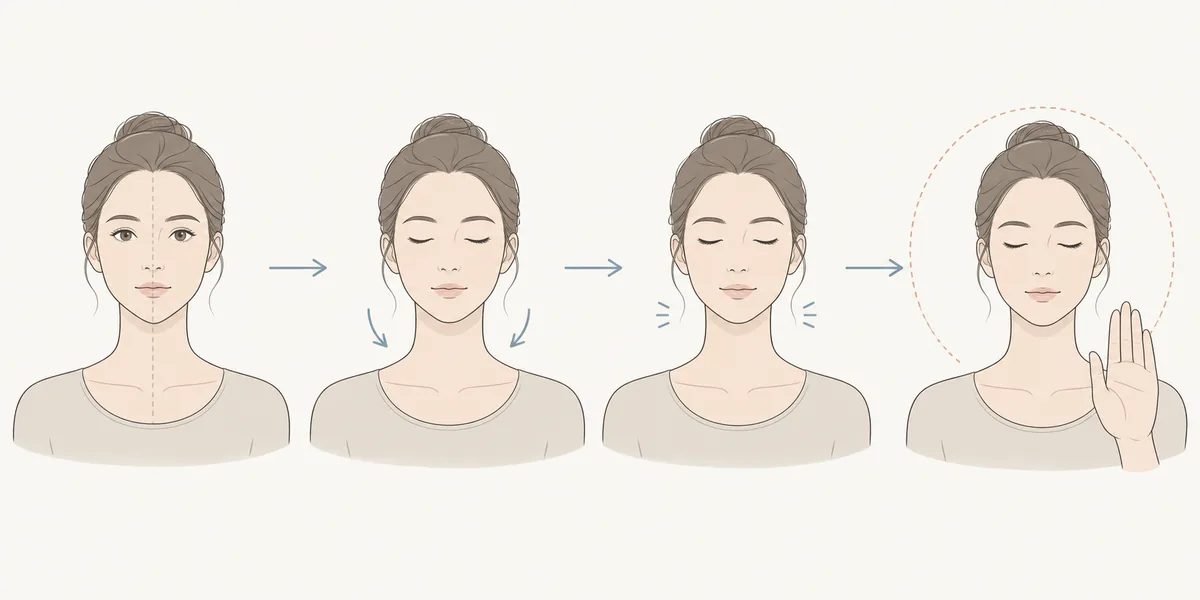
- Set a neutral posture. Sit or stand with the head level, shoulders relaxed, and teeth not pressed together. Let the lips rest without forcing a smile.
- Notice the jaw. Take two slow breaths and check whether one side is clenching. Keep the tongue comfortable and avoid pushing the jaw sideways.
- Use a small movement. Open and close the mouth slowly within a comfortable range, watching for deviation, pain, catching, or a new click.
- Soften the expression. Relax the brow and cheeks, then hold a neutral expression for a few seconds. Do not pull the face into an exaggerated pose.
- Record, do not grade. If you take a comparison photo, use the same distance, light, lens, head position, and expression. Treat the image as a record, not a beauty score.
Why face symmetry exercises have limits
Facial appearance is produced by several layers at once: skin and soft tissue, muscles, fat distribution, teeth and bite, the jaw and other bones, nerves, expression, lighting, and camera perspective. A routine may influence some temporary layers, but it cannot be assumed to change all of them.
This is why a strong before-and-after promise is unreliable. A different focal length, head tilt, smile, or light direction can create a larger visual difference than the exercise itself. Even an AI score can move because the input photo changed, not because the face changed permanently.
Be especially careful with routines that encourage forceful chewing, one-sided resistance, repeated jaw pushing, or painful facial massage. More effort is not automatically more effective, and irritation around the jaw joint can make the problem harder to interpret.
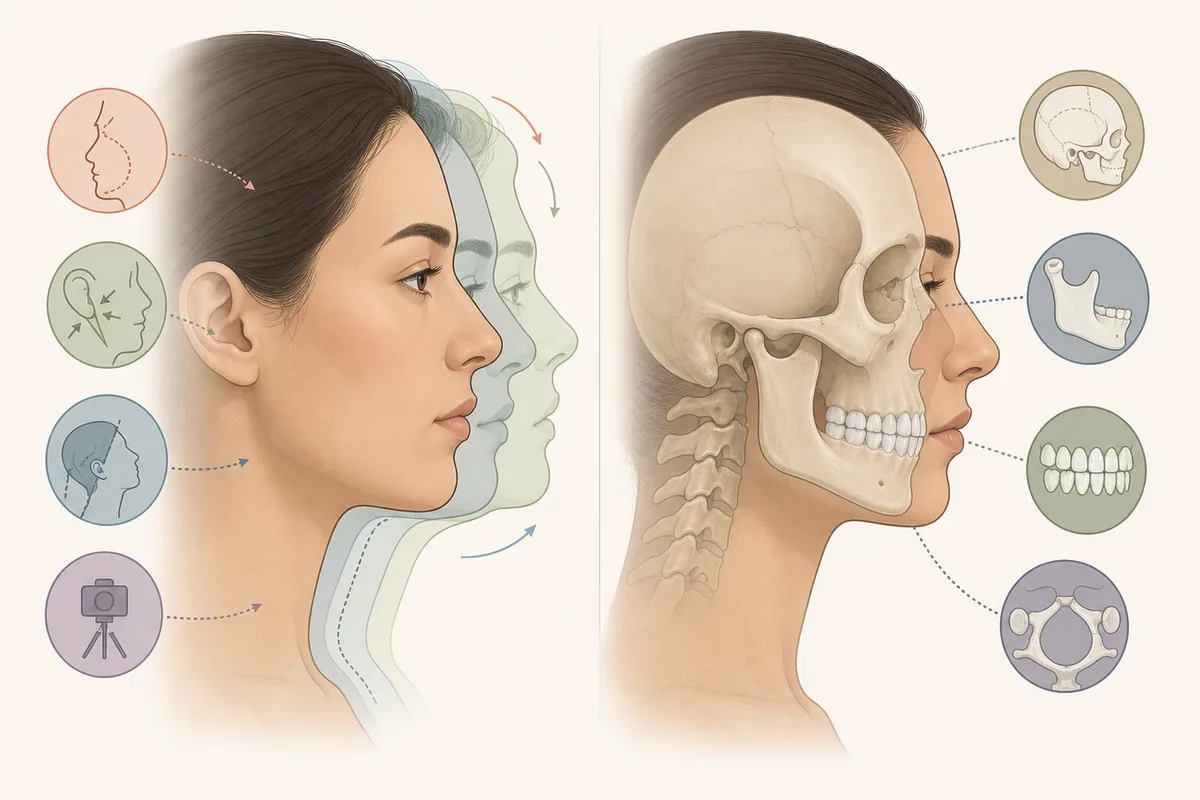
Soft tissue and expression
These can look different with tension, fatigue, swelling, emotion, or a held pose.
Jaw and teeth
Bite, tooth position, and jaw alignment are not reliably changed by generic online exercises.
Camera perspective
Close selfies and uneven light can exaggerate one side without any new physical change.
Nerve or medical changes
New weakness, numbness, drooping, or trouble speaking needs assessment rather than a beauty routine.
When to stop and get help
Stop the routine if you develop jaw pain, locking, worsening headaches, facial pain, numbness, tingling, unusual fatigue, or a new movement that you cannot control. A recurring click without pain is not automatically an emergency, but pain, locking, reduced opening, or a change in function deserves professional advice.
Timing matters. A longstanding mild difference that looks similar in repeatable photos is different from a new change that appeared over hours or days. The latter should not be explained away as a lack of exercise or treated with increasingly forceful movements.
How to check progress fairly
The most useful result is not a single higher symmetry score. It is a clearer answer to three questions: Is the difference repeatable? Is it changing over time? Does it affect comfort or function? A consistent record is more informative than comparing a flattering selfie with a tired close-up.
Use a phone or camera at a greater distance, keep the lens at eye level, use even front lighting, and keep the head and expression neutral. Take two or three photos under the same conditions on different days. If you use an online tool, read the score as a photo-dependent estimate and keep the original images private when possible.
If the concern is mostly cosmetic and stable, a licensed dental, orthodontic, dermatology, or facial-plastic professional can explain which options match the suspected cause. If the concern is sudden, painful, or functional, begin with medical assessment rather than a cosmetic consultation.
- Stable and mild: Compare repeatable photos and decide whether the concern is actually affecting daily life.
- Jaw or bite clues: Ask a dentist or orthodontist about chewing, bite changes, locking, or limited opening.
- Skin, swelling, or a lump: Seek appropriate clinical advice instead of massaging or exercising through a new change.
- Sudden weakness: Treat it as a medical issue and use urgent services when warning signs are present.
The bottom line
Face symmetry exercises are best understood as gentle movement and awareness practices. They may help you relax a clenched jaw, repeat a neutral expression, or take a fairer photo. Those are useful, limited goals.
They are not a reliable shortcut for changing bone position, dental alignment, nerve function, or every long-standing facial difference. When a routine makes promises that exceed those limits, be skeptical and avoid painful or one-sided force.
Start with context: compare consistent photos, notice symptoms and timing, and choose the right professional when function or sudden change is involved. A face does not need to be perfectly symmetrical to be normal, expressive, or worth caring for.
Face symmetry exercises FAQ
Do face symmetry exercises really work?
They may help with awareness, relaxation, posture, or a more neutral expression. Evidence is not strong enough to promise that ordinary home exercises permanently correct bone, dental, nerve, or every structural asymmetry.
Can facial exercises fix an uneven smile?
An uneven smile can reflect expression habits, muscle control, teeth, bite, swelling, or nerve function. A gentle routine should not be used to diagnose the cause. If the change is new, painful, or associated with weakness, seek professional advice.
How long should I do face symmetry exercises?
There is no proven universal schedule for correcting facial asymmetry. If you try a gentle routine, keep it short, comfortable, and easy to stop. More repetitions or stronger resistance are not automatically better.
Can chewing on one side make my face symmetrical?
Deliberately chewing only on one side or pushing the jaw can increase strain and does not reliably correct asymmetry. If chewing feels uneven or painful, ask a dentist or other appropriate professional about the cause.
Should I use an AI face symmetry score before and after exercises?
You can use a score as a photo-dependent reference, but only if the photos use the same distance, lens, lighting, expression, and head position. A changing score may reflect the image rather than a lasting physical change.
When is facial asymmetry urgent?
Sudden facial drooping or weakness, especially with arm weakness, speech trouble, confusion, vision changes, severe headache, or walking difficulty, needs urgent medical help. Do not wait for an exercise routine to work.
References and safety sources
Related guides and tools
Use these pages to separate exercise and posture questions from photo distortion, general facial asymmetry, and professional next steps.
How to Fix an Asymmetrical Face
A broader guide to photo setup, safe options, professional pathways, and warning signs.
Asymmetrical Face Guide
Learn what normal left-right variation can look like and when timing or symptoms matter.
Why Does My Face Look Asymmetrical in Photos?
Understand camera distance, mirroring, light, and pose before judging a change.
Face Symmetry Filter
Compare mirrored left and right previews in the browser without treating the result as a diagnosis.
Face Symmetry Test
Run a photo-based symmetry check with the same privacy and photo-quality cautions.