Does Sleeping on Your Side Make Your Face Asymmetrical?
A calm guide to what side sleeping can change temporarily, what it probably cannot prove, how to compare photos fairly, and when a new facial change needs professional care.
Written by Clara Bennett
Editorial note: This guide is informational. It cannot diagnose a facial nerve problem, dental condition, injury, or other health issue.
The quick answer
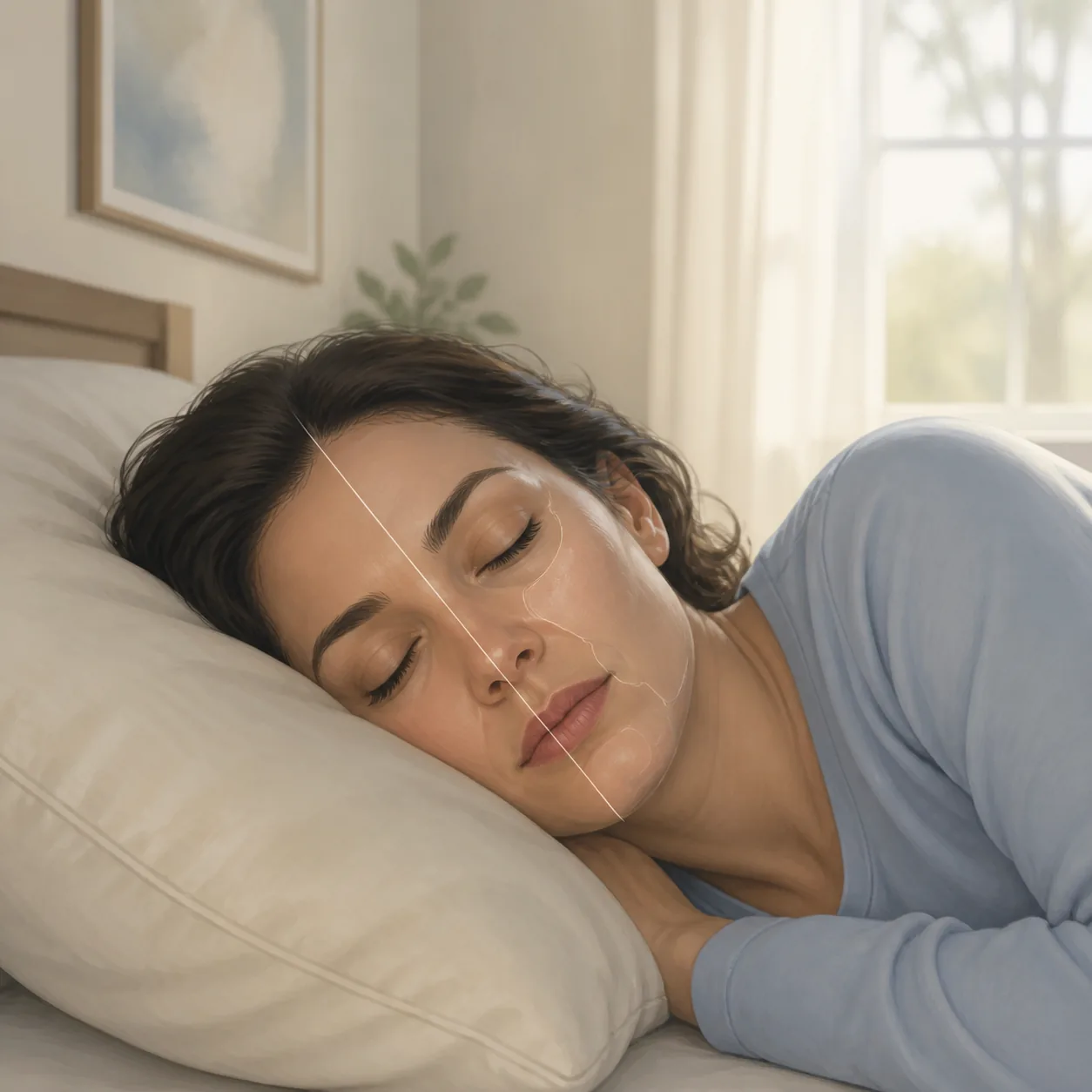
Usually, no. Sleeping on one side for a night does not by itself prove that it has permanently reshaped an adult face. It can leave temporary pressure marks, morning puffiness, a different expression, or jaw tension. If the same difference remains in repeatable, front-facing photos, think more broadly about normal facial asymmetry, dental or jaw factors, injury, or medical causes—not sleep position alone.
If you searched this after waking up with one cheek, eye, or side of your jaw looking different, you are not alone. A pillow can press on soft tissue, a face can look puffy after sleep, and the first mirror view of the day is rarely a controlled comparison. Those clues can make a temporary difference feel like a permanent change.
Side sleeping is a reasonable thing to investigate, but it is not a reliable diagnosis. The more useful question is whether the difference disappears as you wake up, changes with expression, appears only in a close selfie, or stays consistent across several similar photos. A stable difference can be ordinary facial variation; a new loss of movement is a different category of problem.
This guide separates appearance and photo questions from health warning signs. It explains what you can observe at home, what a face symmetry tool can and cannot tell you, and when a dentist, clinician, or urgent service is a better next step.
Can Side Sleeping Permanently Change Your Face?
There is no simple before-and-after photo that can prove side sleeping alone caused a permanent facial change. An adult face reflects bone, teeth, jaw movement, soft tissue, skin, expression, and the way the camera records depth. Sleep position is only one possible context, and it is easy to confuse a temporary morning effect with a structural change.
Pressure from a pillow may leave a mark or make one side look fuller for a short time. Morning fluid retention can also make the cheeks or eyelids appear different before the face returns to its usual appearance. Jaw clenching, tooth grinding, nasal congestion, or sleeping poorly may affect muscle tension and expression, but a photo cannot identify the cause by itself.
If you have noticed a gradual, persistent difference, do not reduce the explanation to sleep position. Ask whether there are bite changes, jaw pain, dental work, an old injury, swelling, skin changes, or a new movement problem. The goal is not to find a beauty hack; it is to match the next step to the pattern.
Temporary pressure
A pillow can leave an indentation or make one side look compressed when you first wake up.
Morning puffiness
The face may look different before normal movement, hydration, and time reduce the effect.
Muscle tension
Clenching or grinding may make the jaw feel tight, but it does not prove that sleep posture changed the bones.
Stable structure
Long-standing differences may come from normal growth, teeth, jaw shape, soft tissue, or expression habits.
Why Your Face May Look Uneven After Sleep
The phrase “my face is asymmetrical after sleeping” can describe several different experiences. One person may be seeing a temporary cheek mark; another may be comparing a familiar mirror image with an unflipped phone photo; someone else may have jaw discomfort or a genuinely new weakness. These situations should not be treated as the same problem.
Use the table as a sorting tool, not as a diagnosis. It helps you decide what to observe next. If a pattern is new, worsening, painful, or connected to movement or sensation, appearance advice is not enough.
A close front-camera image is especially poor evidence because lens distance, head tilt, lighting, and expression can exaggerate small left-right differences. A fair comparison uses the same setup each time and gives more weight to repeated patterns than to one surprising image.
| Possible factor | What you may notice | What it does not prove |
|---|---|---|
| Pillow pressure | A temporary line, flattened cheek, or different-looking side immediately after waking. | That the facial bones have shifted or that the effect will last. |
| Morning puffiness | One eyelid or cheek looks fuller and gradually settles during the day. | That the face has become permanently asymmetrical. |
| Jaw tension | Tightness, tenderness, a tired jaw, or a change in how the bite feels. | That sleeping on one side is the only cause. |
| Photo geometry | The difference appears in a close selfie but not in a farther, level portrait. | That your face looks the same from every angle in real life. |
| New facial weakness | Drooping, trouble smiling or blinking, numbness, or a sudden change in movement. | A cosmetic issue; it needs medical assessment. |
How to Check It Fairly
Before deciding that side sleeping changed your face, repeat the observation under controlled conditions. You do not need a perfect photograph. You need a few comparable photographs that reduce camera distortion and show whether the pattern is stable.
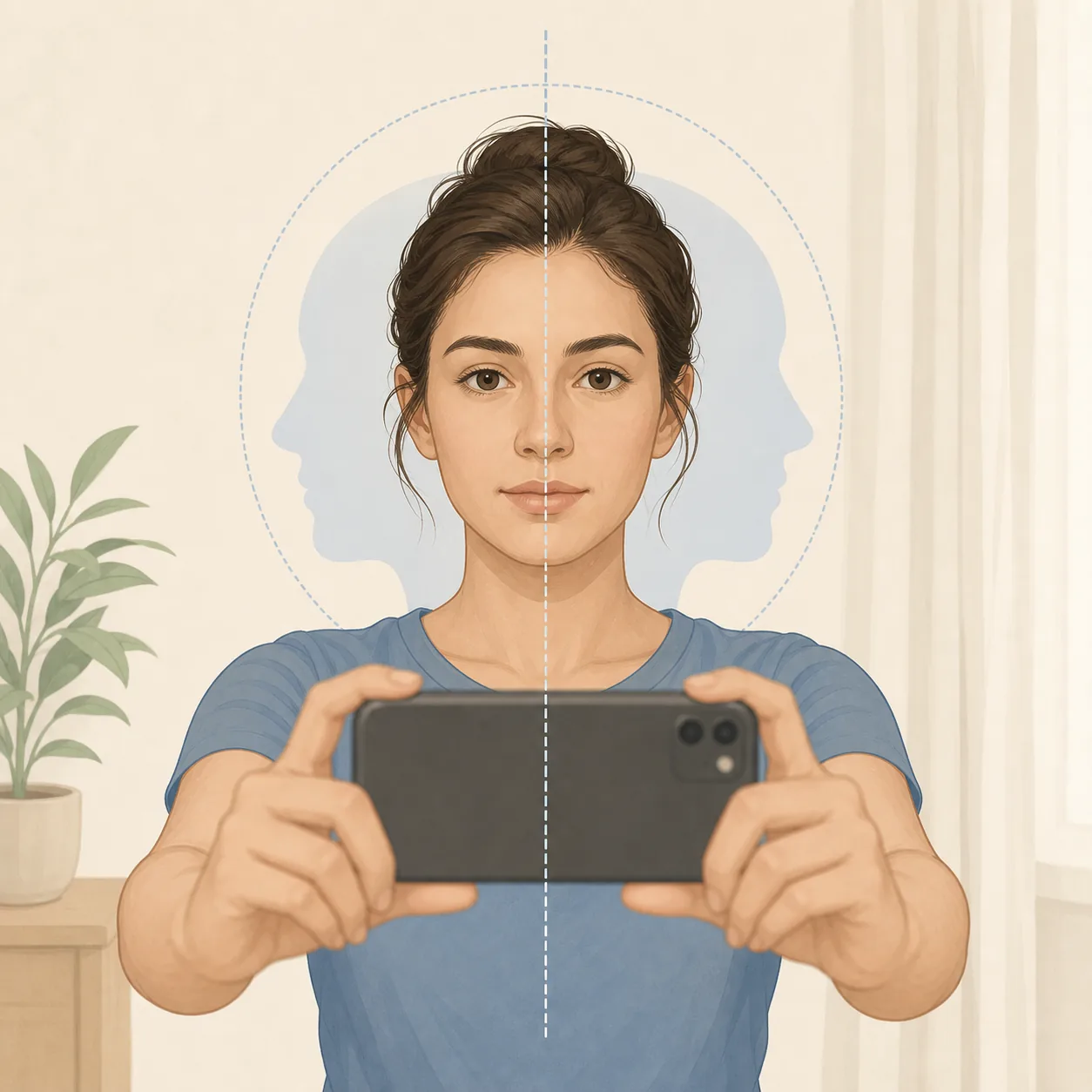
Take the photos at a similar time of day, after you have been awake long enough for the first morning impression to settle. Keep the phone at eye level, step back instead of holding a wide-angle lens close to your face, use soft front light, and relax your mouth. Compare two or three images rather than a mirror view and a single selfie.
- Wait and observe Notice whether puffiness, a pillow mark, or a tired expression changes during the first part of the day.
- Use a repeatable setup Keep the camera level, the distance similar, and the light even so the comparison is meaningful.
- Relax the jaw Do not clench your teeth or force a smile; note pain, clicking, or bite changes separately from appearance.
- Compare several photos A pattern that repeats is more useful than one image that looks unusual.
- Record function and timing Write down when the change began and whether movement, sensation, speech, eye closure, or swelling also changed.
What You Can Try Safely
If the difference is mild, long-standing, and mainly visible in the morning or in photos, start with low-risk observation. Choose a pillow and sleep position that let you breathe and rest comfortably; you do not need to force yourself into an uncomfortable position to chase a perfectly symmetrical face. Better sleep is a more useful goal than a cosmetic score.
If you have jaw soreness, headaches, tooth sensitivity, or repeated signs of grinding, ask a dentist or clinician whether those symptoms deserve assessment. If the concern is mostly photographic, use the photo checks above and read a symmetry score as a description of one image, not a diagnosis. Avoid making decisions about exercises, fillers, surgery, or aggressive massage from one result.
- Improve the comparison: Use a farther, level camera and even lighting before interpreting a photo.
- Protect comfort: Do not sacrifice breathing, sleep quality, or neck comfort to avoid one sleeping position.
- Track symptoms: Note jaw pain, bite changes, swelling, numbness, weakness, or changes that persist after waking.
- Choose the right professional: Dental and jaw concerns may need a dentist; sudden movement or sensation changes need medical care.
- Keep tools in context: A face symmetry test can support photo comparison, but it cannot explain why a difference exists.
When Facial Asymmetry Needs Medical Attention
A stable, mild difference is often not urgent. A sudden change is different. If one side of the face suddenly droops or feels weak, if you cannot smile or close one eye normally, or if new numbness appears, do not wait for a beauty filter or sleep-position experiment to explain it.
Get urgent help when facial change appears with trouble speaking, arm or leg weakness, confusion, severe dizziness, a severe headache, or difficulty walking. These symptoms can signal an emergency. Other new problems, such as facial pain, injury, rapidly increasing swelling, or persistent inability to close an eye, also deserve prompt professional assessment.
Online articles and AI tools can help you describe what you noticed, but they cannot rule out a neurological, dental, infectious, or injury-related cause. When timing and function change, safety matters more than symmetry.
Bottom Line
Side sleeping can make one side look different for a while because of pressure, morning puffiness, expression, or jaw tension. That is not the same as proving that side sleeping permanently made your face asymmetrical. Give the first morning impression time to settle, then use repeatable photos and note any functional symptoms.
If the difference is persistent, painful, progressively changing, or connected to movement or sensation, look beyond sleep position and ask the appropriate professional. If it is only a photo effect, a fairer camera setup may solve the mystery.
FAQ
Can sleeping on one side make your face asymmetrical?
It can make one side look temporarily different because of pillow pressure, morning puffiness, expression, or jaw tension. A single night does not prove permanent structural asymmetry.
Does side sleeping cause permanent facial asymmetry?
There is no simple way to attribute a persistent facial difference to side sleeping alone. If a change remains, consider normal facial variation, dental or jaw factors, injury, swelling, or medical causes and seek appropriate advice when needed.
How do I fix face asymmetry from sleeping on my side?
First check whether the difference settles after waking and repeats in fair photos. Protect comfortable sleep, avoid aggressive massage or unproven exercises, and discuss persistent jaw symptoms or a lasting change with a qualified professional.
Why does my face look more uneven in the morning?
Temporary pressure, puffiness, dehydration, tired facial muscles, jaw clenching, and the first unflattering light of the day can all change the way a face appears. Recheck later under the same photo conditions.
Should I sleep on my back to make my face more symmetrical?
There is no universal need to change a comfortable sleep position for a cosmetic reason. Prioritize breathing, sleep quality, and neck comfort; ask a clinician if snoring, pain, or another sleep problem is involved.
When is sudden facial asymmetry an emergency?
Seek urgent help for sudden drooping or weakness, new numbness, trouble speaking, confusion, arm weakness, severe dizziness or headache, or difficulty closing one eye. Do not rely on an online symmetry test to assess those signs.
Sources and limits
The links below support the safety distinction between ordinary appearance concerns and sudden facial weakness. They do not prove that a particular sleep position caused an individual change.
- Penn Medicine — Facial Asymmetry — Overview of facial asymmetry and possible causes.
- NHS — Act FAST — Public guidance on sudden stroke warning signs, including facial weakness.
- Mayo Clinic — Bell's Palsy — Medical overview of sudden one-sided facial weakness and related symptoms.
- Face Symmetry Test — Privacy Policy — Read how this site's photo-processing and privacy information is presented before uploading an image.
Related resources
Use these pages for the part of the question they actually answer; do not treat a photo score as a diagnosis.
Asymmetrical Face Guide
Causes, normal signs, photo distortion, and when a sudden change needs care.
Why Does My Face Look Asymmetrical in Photos?
Camera distance, mirroring, lighting, and pose checks for confusing selfies.
Face Symmetry Exercises
What gentle exercises may help with awareness and what they cannot change.
How to Fix an Asymmetrical Face
A broader guide to safe photo, dental, skin, and medical next steps.
Face Symmetry Test
Compare a clear front-facing photo with a score that describes the uploaded image.